
What is device lifecycle management, and why should Indian IT teams care?
Device lifecycle management (DLM) is the process of managing every stage of a business device: procurement, deployment, day-to-day support, refresh, and disposal. Device lifecycle management India programmes help companies reduce IT costs, eliminate downtime, and keep their device fleet compliant without upfront capital expenditure.
If you manage 50 or more laptops, tablets, or mobile phones, you already have a device lifecycle problem. Most companies just have not named it yet.
The laptop a new employee picks up on day one will go through roughly five phases before it is retired. Without a structured device lifecycle management India framework, most businesses handle each phase separately: a purchase order here, a support call there, an IT manager chasing a vendor for a replacement. That works at 10 devices. At 100 it becomes a full-time job. At 500 it is a liability.
Device Lifecycle Management is the structured answer to that. New to the term? Our 6-stage device lifecycle management walkthrough covers the fundamentals before you read the India-specific numbers below.
What are the five stages of device lifecycle management?
A device lifecycle has five stages, and cost leakage happens when you treat them as separate events.
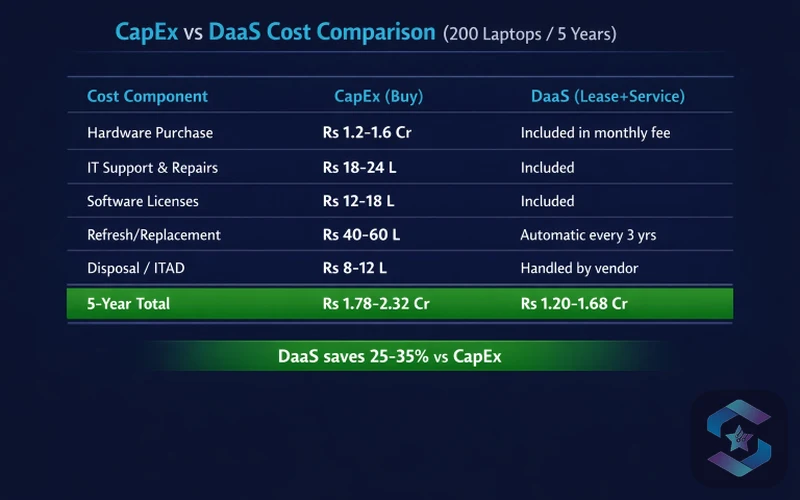
Procurement is where most companies make their first mistake. They buy hardware outright in one large capex hit, with no refresh plan. If you are weighing that decision right now, compare DaaS vs traditional procurement with real rupee figures before you commit. Three years later the devices are slow, out of warranty, and the IT budget has nothing left for replacements.
Deployment covers everything between the box arriving and the employee being productive: imaging, software installation, Active Directory enrolment, MDM configuration, asset tagging. Companies managing this ad hoc lose an average of two working days per device before the employee is fully operational.
Day-to-day management is the largest ongoing cost: helpdesk tickets, security patches, warranty claims, spare device management, user offboarding. Without a system, your IT team spends more time firefighting than working on anything strategic.
Refresh is the phase nobody plans for until it is urgent. Devices older than three years cost more to support than they save. A proper DLM programme includes a refresh schedule baked in from day one, so you are not scrambling when a field team’s tablets start failing mid-quarter.
Disposal is often the weakest link in any device lifecycle management India rollout. Hard drives containing customer data, financial records, or employee PII (sitting in a storeroom or handed to a local vendor) are a data breach waiting to happen. Proper IT asset disposal (ITAD) requires certified data destruction and documentation. Under the DPDP Act, that documentation is no longer optional, and under the E-Waste (Management) Rules, 2022, retired devices must be routed through an authorised recycler, not a local scrap dealer.

What is Device-as-a-Service (DaaS) and how does it connect?
Device-as-a-Service is the DLM model where a company pays a fixed monthly fee per device instead of buying hardware outright. The fee covers the device, deployment, support, refresh at the end of the contract, and certified disposal. Capex becomes opex.
For a mid-market company in pharma or BFSI, that shift matters. A laptop that costs ₹80,000 upfront becomes roughly ₹1,800 to 2,200 per month over a 36-month cycle, with support, refresh, and certified disposal included. The CFO gets a predictable IT line item. The IT head gets a managed service instead of a hardware problem.
At Sirius Star, we currently manage 2,500-plus devices for clients across pharma, logistics, and financial services. One national insurer moved their entire field force (400-plus devices) to a DaaS model. Their support tickets dropped roughly 40% in the first quarter.
Who actually needs DLM?
DLM is not for every company. If you run 10 laptops and have someone technically capable handling support, a structured DLM programme is more overhead than it is worth. Buy your devices, keep a spare, move on.
DLM starts making financial sense somewhere around 50 devices. At that point, the cost of unmanaged devices (productivity lost to downtime, time spent on ad hoc procurement, data risk from untracked assets) starts to exceed the cost of a proper programme.
The sectors where we see the clearest DLM payoff in India:
- Pharmaceutical companies with large field forces carrying medical rep tablets and data-logging devices
- NBFCs and insurance companies with distributed teams needing auditable, compliant device records
- Logistics and distribution companies where devices move between staff and locations constantly
- Manufacturing plants with ruggedised devices on the shop floor that need remote management and policy enforcement
If your IT head is spending more than 30% of their week on device-related support calls, you have a device lifecycle management problem.
The hidden costs most IT budgets miss
Most Indian IT budgets account for the hardware cost. Almost none account for what comes after.
Deployment time alone (per device, including imaging, MDM setup, and user onboarding) runs 4 to 6 hours of IT staff time. Multiply that by 200 devices and you have spent a full month of someone’s salary just getting devices out of boxes.
Support tickets average 3 to 5 per device per year. At 200 devices that is 600 to 1,000 escalations annually. At an hourly cost of even ₹500 for IT staff time, you are spending ₹3-5 lakh a year reacting to problems that a managed programme would prevent or handle faster.
The first three years of device ownership feel cheap. The fourth year feels expensive. Depreciation is invisible; support costs are not.
A managed DLM programme makes those costs visible and predictable from day one.
What to look for in a DLM partner in India
Not all DLM providers are equal. A few things worth checking before you sign anything.
Does the provider handle the full lifecycle, or just procurement? Many resellers call themselves DLM vendors but only supply hardware. Support, refresh, and ITAD are billed separately or not offered at all.
Do they support multi-brand environments? Your fleet likely includes Dell, Lenovo, Apple, and Samsung. Your DLM partner should manage all of them, not only the brand they sell.
What MDM platform do they use? Mobile Device Management software (Samsung Knox, SOTI, Scalefusion, or Microsoft Intune) is what enables remote device management, policy enforcement, and remote wipe. Without MDM, you do not have DLM. You have a spreadsheet.
Can they handle certified data destruction at end of life? Ask for a data destruction certificate. If they cannot provide one, the liability stays with you under the DPDP Act.
Sirius Star is a Samsung Certified Partner and Microsoft Partner with pan-India delivery across 19,000+ pincodes. We manage devices across brands and handle the full lifecycle: procurement, MDM configuration, support, refresh, and certified ITAD. You can read a full breakdown of how to choose the right MDM software before making any vendor decision.
How to run a quick DLM audit on your own fleet
Before you call anyone, do this internally:
- List every device in your fleet: type, age, assigned user, location
- Flag every device older than 36 months (immediate refresh candidates)
- Count IT support tickets raised last quarter and estimate how much staff time they consumed
- Check your disposal process: what actually happened to the last five devices you retired?
That exercise will tell you, honestly, whether you have a DLM problem. If three or more devices are unaccounted for, or if you cannot produce a data destruction record for retired hardware, you already have one.
The next step is a professional Device Fleet Audit. We offer it free for companies with 50-plus devices. It covers fleet health, refresh urgency, support cost analysis, and a DaaS versus capex comparison specific to your situation.
You can also compare DaaS versus traditional device procurement to see which model fits your growth stage. A guide written specifically for CFOs evaluating the numbers.
Arjun’s Take
I had a call last month with an IT head at a 300-person pharma company. They had 180 laptops across four states, no asset register, and three devices they could not locate. Two of those had field data on them. That is not an IT problem. It is a compliance and data risk problem wearing an IT uniform. Once you put a proper DLM structure in place, those situations stop being possible. The device either shows up in your MDM console or it triggers an alert. There is no grey zone.
Arjun Mehta, Device Operations Specialist, Sirius Star Enterprise Technologies Pvt. Ltd.
FAQ
What does device lifecycle management mean?
Device lifecycle management (DLM) is the end-to-end process of managing business devices, from procurement and deployment through day-to-day support, scheduled refresh, and certified disposal. The goal is to reduce IT costs, minimise downtime, and ensure devices are retired securely.
Is DaaS the same as DLM?
Not exactly. DLM is the management framework for your entire device fleet. DaaS (Device-as-a-Service) is the commercial model where you pay a monthly fee per device instead of buying hardware upfront. DaaS typically includes full DLM (setup, support, refresh, and disposal) bundled into one monthly cost.
How much does device lifecycle management cost in India?
A DaaS model in India typically runs between ₹1,500 and ₹2,500 per device per month, depending on device type, support tier, and contract length. That includes the hardware, MDM setup, helpdesk support, and end-of-cycle refresh. Most companies find DaaS costs 15-25% less over a three-year period compared to buying outright and managing support in-house.
How do I know if my company needs DLM?
If you manage more than 50 devices, have hardware older than 36 months in active use, cannot account for every device in your fleet, or your IT team spends significant time on device-related tickets. A structured DLM programme will pay for itself within two quarters.
What happens to devices at end of life under DLM?
Devices are collected, data is wiped using certified tools (generating a data destruction certificate), and the hardware is recycled or refurbished responsibly. This protects you from data breach liability and satisfies DPDP Act requirements for personal data disposal.
Get a free Device Fleet Audit
200+ businesses trust us. Response within 24 working hours.
Prefer to talk it through? Book a call with our DLM team
The longer read for Indian buyers who want the real numbers before they commit.
Send me the field guideA note from the author
Most IT teams I work with know device lifecycle management is important. They still run it as a series of reactive tickets. The shift from reactive to programmatic is less about software and more about decisions you make once and follow every quarter. When do we refresh? Who touches the device on day zero? What does offboarding actually cost when the user has left the building? If you answer those three questions on paper and stick to the answers, the rest of DLM is tooling.
The 4,000-endpoint rollout I did before Sirius Star taught me one thing above everything else: fleets don’t fail because the MDM is wrong. They fail because nobody wrote down what the MDM is supposed to enforce. Start with the policy. The platform is the last decision, not the first.