
Device Lifecycle Management: From Day One to Secure Disposal
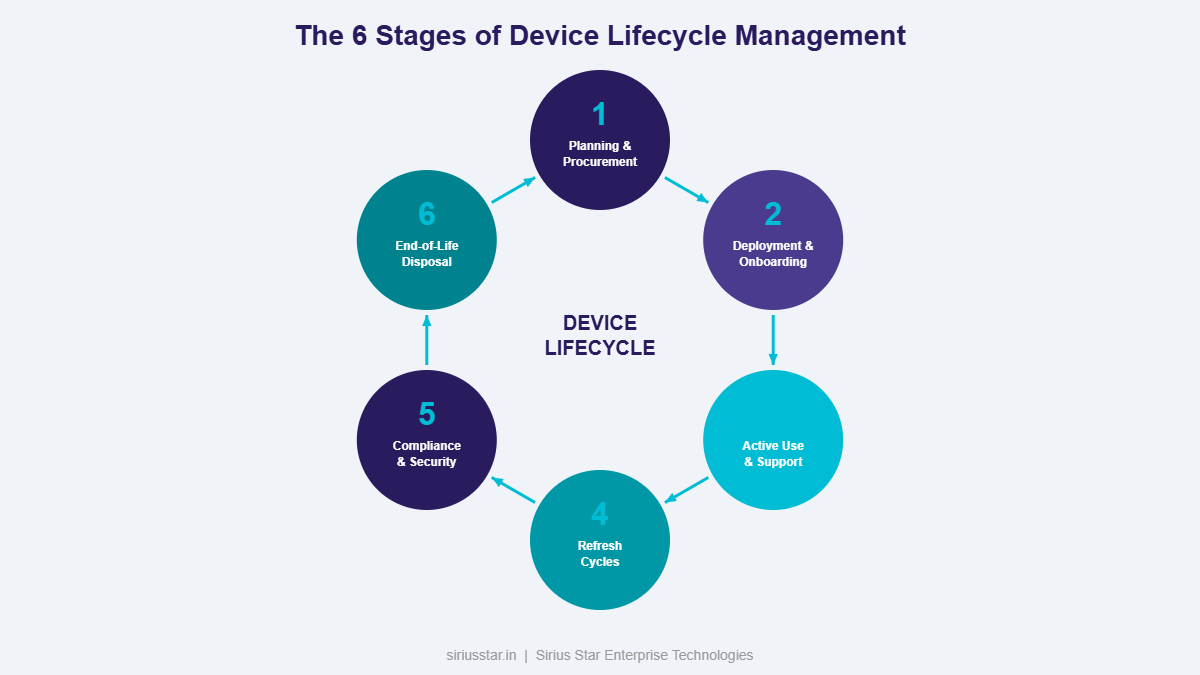
DLM is the practice of managing every IT device your company owns from purchase to recycling. It covers 6 stages: planning, procurement, deployment, support, refresh, and disposal. Companies with 200+ devices that run DLM properly cut hardware waste by 30-50% and eliminate data breach risk during disposal. For the legal requirements around IT asset disposal in India, see our complete guide to IT asset disposal compliance. Already sold on the concept? Our device lifecycle management India guide breaks down real DaaS pricing and what to look for in a partner.
A typical enterprise with 500 devices spends ₹2 crores on hardware over 5 years. Of that, 30-40% goes to downtime, failed repairs, and data breach cleanup. Smart DLM cuts that waste in half.
What is device lifecycle management?
Device Lifecycle Management is the practice of managing IT devices through every stage of their life: planning, procurement, deployment, support, refresh, and secure disposal. Laptops, tablets, phones, printers – anything your employees use to do their jobs.
Think of it like maintaining a fleet of cars. You don’t just buy vehicles and hope they work. You schedule maintenance, track fuel costs, plan replacements, and handle scrappage responsibly. DLM is exactly that for enterprise devices.
The six stages are:
- Planning and procurement — forecast need, negotiate contracts, lock in volume discounts
- Deployment and onboarding — unbox, configure, enroll in MDM, assign to users
- Active use and support — monitor health, patch updates, handle repairs
- Refresh cycles — when devices age, decide: repair, repurpose, or retire
- Compliance and security — wipe data, verify disposal standards, meet DPDP Act requirements
- End-of-life disposal — recycle responsibly, get destruction certificates, meet e-waste rules
What changes when you have DLM in place: devices get fixed faster (mean time to repair drops from 7 days to 2), you know exactly what devices you own, data does not leak during disposal, you forecast hardware costs accurately, and downtime drops.
Why device ownership without DLM is expensive
Most companies just buy devices and react when things break. What that costs for a company with 200 laptops and no DLM system:
- Average device age: 5 years (way too old for reliable performance)
- Support tickets per month: 25-30
- Failed drive replacements: 15% of fleet per year
- Average downtime per repair: 3-5 days
- Devices “lost” in the system: 20-25% of the fleet
Total annual waste: ₹45-60 lakhs.
Now add data breach risk. When devices fail without proper wiping protocols, sensitive data stays on hard drives. That is how pharma companies leaked MR call data, how financial firms exposed customer records. One breach can cost 10x your entire DLM budget.
DLM prevents this by enforcing predictive maintenance (replace before failure), centralized asset tracking (know where every device is), automated compliance workflows (no human error on data wiping), and vendor accountability.
DaaS vs ownership: the DLM advantage
There are two ways to run DLM. You either own devices and manage their lifecycle yourself, or you lease them through Device-as-a-Service and let the vendor handle it.
Ownership + self-managed DLM: You own the device, control everything. Upfront cost is ₹80,000-1,20,000 per device. 5-year lifespan, then you deal with disposal. You manage repairs, vendors, compliance. The advantage is control. The disadvantage is complexity.
Device-as-a-Service (DaaS): The vendor owns the device, you lease it. Monthly cost is ₹2,000-3,500 per device, all-in: hardware, support, replacement. Device fails? Swap within 4 hours. We do this at Sirius Star. Vendor handles repairs, compliance, disposal. The advantage is simplicity and predictable cash flow.
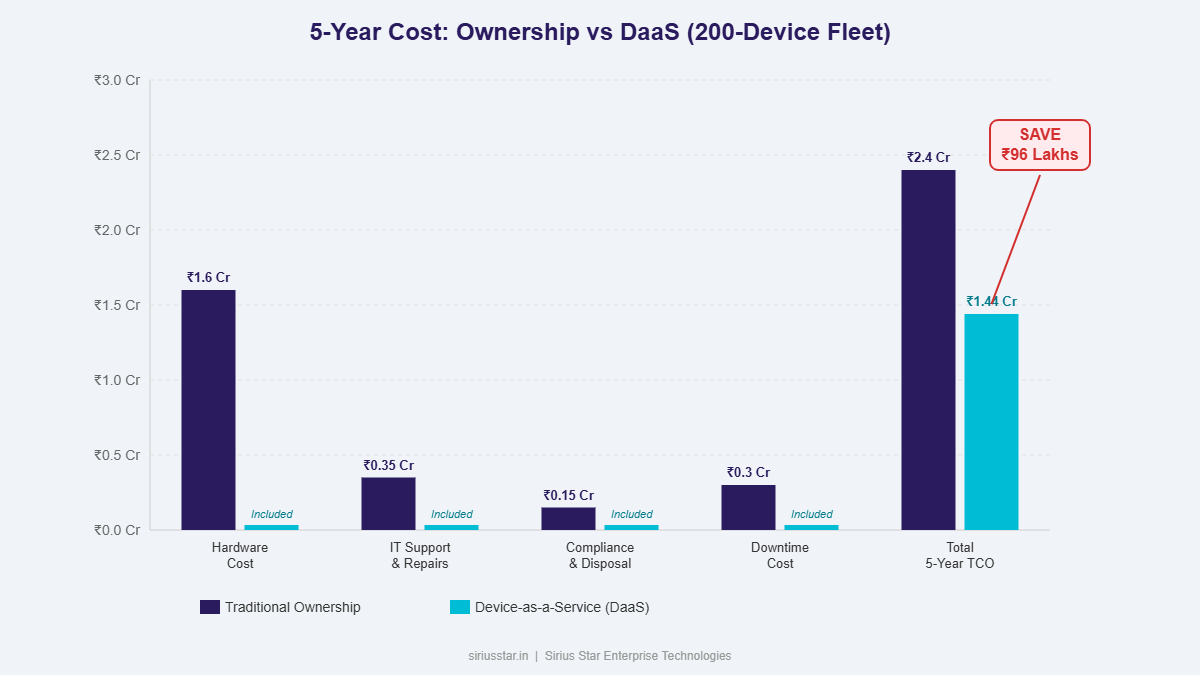
For a 200-device company over 5 years:
- Ownership: ₹1.6-2.4 crores + internal IT overhead
- DaaS: ₹1.2-1.68 crores (everything included, predictable)
- Savings: ₹20-60 lakhs, plus zero compliance risk
The catch: you lose some control over device specs. Many companies want both – workstations owned for engineers, tablets on DaaS for the field force. That hybrid model works well.
The 6 stages of DLM explained
Stage 1: Planning and procurement
Forecast device need 6-12 months ahead. Decide: do you need the latest specs or is 3-year-old refurbished fine for your use case? Negotiate volume contracts. A 200-device order gets you 15-20% discount vs retail. This stage sets the tone for the next 5 years.
Stage 2: Deployment and onboarding
Devices arrive. You configure them: MDM enrollment, VPN setup, compliance tooling. In a DaaS model, the vendor does this. In an ownership model, your IT team does it. Either way, it takes 2-3 hours per device. Pre-configured devices save 40% of this time.
Stage 3: Active use and support
Devices are deployed. Tickets come in: “My laptop is slow.” “Printer won’t connect.” A good DLM system prioritizes tickets, tracks mean time to repair, and predicts failures before they happen. This is where most companies waste money – reacting instead of preventing.
Stage 4: Refresh cycles
Year 3-4, devices age. Batteries don’t hold charge. Keyboards fail. You make a choice: repair (if it costs under 30% of device value), repurpose (older devices for less-demanding roles), or retire (send for recycling). The wrong choice here costs more than the device itself.
Stage 5: Compliance and security
Before any device leaves your control, it must be wiped. Not just “delete files.” Full disk wipe, verified. NIST 800-88 standard, data destruction certificate. This is non-negotiable under DPDP Act 2023.
Stage 6: End-of-life disposal
Devices go to certified e-waste recyclers. You get a certificate of destruction. Compliance verified. This is not optional, it is the law, and the penalties are steep.
DLM for different industries
Pharma (field force): 2,000+ tablets in MR hands across 10 states. MDM locks down Veeva CRM access. Samsung Knox prevents data export. When an MR leaves, remote wipe happens in 15 minutes. Pharma companies lose ₹50+ lakhs per year to competitors accessing call data through unsecured devices.
Banking and insurance: Highly regulated. Every device is a compliance asset. DLM includes immutable audit logs, biometric authentication, constant encryption. One missing device can trigger regulatory fines.
Retail: 1,000+ POS terminals across stores. DLM monitors every register. If a terminal fails during peak hours, remote diagnostics identify the issue, and a replacement ships overnight. Downtime equals lost sales.
Education: Devices for students are high-wear, low-value. DLM handles bulk replacements, tracks device misuse, and manages the refresh cycle efficiently.
Common DLM mistakes that cost real money
Mistake 1: “We track devices in Excel.” A 200-device fleet in Excel? One wrong entry, and your IT team spends hours chasing a phantom device. You cannot forecast maintenance or compliance gaps from a spreadsheet.
Mistake 2: “We only wipe devices when someone leaves.” Disgruntled employee, last day of work, IT team distracted, data wipe gets skipped. Months later, that used device ends up on Flipkart, buyer finds sensitive files. DPDP Act penalty: up to ₹250 crore.
Mistake 3: “We buy the cheapest option.” A ₹35,000 laptop vs ₹60,000 laptop might seem like a ₹25k saving per unit. But the cheap device fails after 2.5 years. The expensive one lasts 4.5 years. Over 5 years, total cost of ownership is actually higher for the cheap device, plus triple the repairs.
Mistake 4: “We don’t plan for disposal.” Devices hit end-of-life, and you scramble for a recycler. Your CFO finds a “cheap” recycler who promises ₹500 per unit. Data is not wiped properly. Your risk spikes.
Frequently asked questions about DLM
How much does DLM actually cost?
It depends on whether you self-manage or use DaaS. Self-managed DLM costs 10-15% of hardware cost per year. DaaS bundles it into a monthly lease. For a 200-device fleet, budgeted cost is ₹15-25 lakhs annually, versus ₹45-60 lakhs in waste from bad DLM. The math is clear.
Do we need DLM if we only have 50 devices?
Yes. Even small teams lose devices, forget to wipe them, and overpay for repairs. DLM discipline scales down. A simple MDM plus asset tracker costs ₹50k per year and prevents one data breach, which costs ₹10+ lakhs. ROI is immediate.
Can we use our MDM tool as DLM?
No. MDM handles security on active devices. DLM is broader: procurement, support, refresh, disposal. MDM is one piece of DLM. You need both.
Ready to cut your device costs by 30%?
Take our free device audit. We will assess your current fleet, spot waste, and show you the exact savings you can unlock in 30 days.
200+ businesses trust us. Response within 4 hours.
Or WhatsApp us directly for a quick chat.
Sources
1. India’s average data breach cost hits ₹220 million in 2025, AI security gaps emerge: IBM report, BusinessToday / IBM, 2025
2. IDC Worldwide Quarterly PC Tracker, IDC, enterprise device refresh cycle and market data
3. DPDP Act 2023 and DPDP Rules 2025: Compliance Guide, EY India, 2025
4. NIST Special Publication 800-88 Rev. 2: Guidelines for Media Sanitization, NIST, 2024
5. E-Waste (Management) Rules, 2022, Central Pollution Control Board
Arjun’s Take: I’ve managed device fleets for insurance companies, pharmaceutical firms, and banks for 15 years now. The mistake I see every time is companies waiting until devices start failing to think about lifecycle management. By then, they’ve lost lakhs in downtime and created data risk. The pharma company that lost MR data to a secondhand device on Flipkart, we could’ve prevented that with a single DLM wipe protocol. Start DLM when you buy the device, not when it breaks.
Chat with us on WhatsApp: Start a conversation about your device fleet | 200+ businesses trust us. Response within 4 hours.
Your devices are either managed or they’re a liability. Which one are you?
30 minutes. Free assessment. No obligation.
200+ businesses trust us · Response within 4 hours
Not ready for a call? Take something useful.
30 SECONDS
Follow Our CEO- Sudeep Kumar on LinkedIn for weekly IT insights
Follow →
2 MINUTES
Download the DPDP Compliance Checklist
Download →
5 MINUTES
Read how we manage 2,500 devices for a national insurer
Read →
The longer read for Indian buyers who want the real numbers before they commit.
Send me the field guide