
Securing the office printer
A mid-sized CA firm in Bengaluru ran one shared multifunction printer that scanned every client’s PAN card, bank statement and Form 16. Nobody had ever changed its admin password. Here is what securing that one printer actually took, and why it mattered more than anyone in the office expected.
The printer that knew everyone’s PAN number
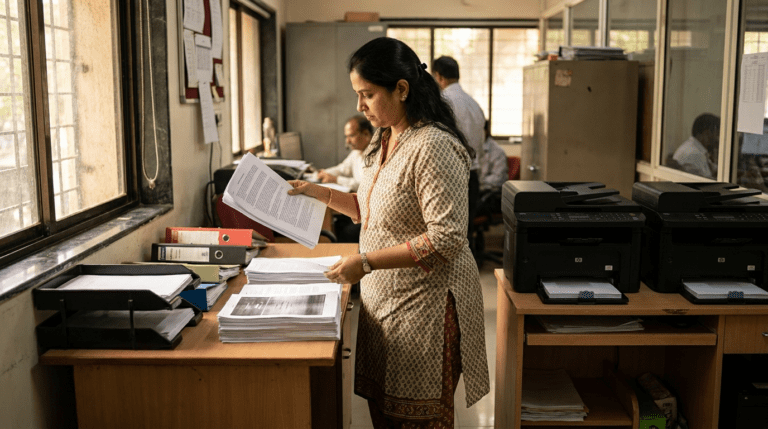
Anil runs a chartered accountancy practice in Bengaluru. Around thirty people, three partners, and a filing season that turns the whole floor into a paper factory. He called me in about something small. Printing was slow in March and he wanted to know whether to add a second machine.
While he made tea I walked over to the printer. A decent Brother mono laser multifunction, the kind that quietly does the work of four devices. I asked him one question over the thanda chai. Who knows the admin password? He laughed. Nobody. It came set up years ago and it has just run.
So I opened a browser on their office wifi and typed the printer’s address. The web console loaded straight away. No login. From there I could see the scan-to-email setup, which held a mailbox and its password in plain reach. I could see the internal drive, and on it, months of scanned jobs. Client PAN cards. Bank statements. Salary slips. Every sensitive document the firm had touched since the last time the machine was wiped, which was never.
Why the office printer is the device nobody secures
Anil is not careless. His laptops have antivirus. His firewall gets renewed. His accounting software sits behind a login he changes. He had done the obvious things. The printer just never made the list, because in his head it was furniture, not a computer.
That is the normal blind spot in an Indian SMB. A modern multifunction device runs an operating system, holds storage, sits on the network and serves a web admin page. It is a small server that happens to also print. But it lives in a corner, everyone shares it, and no single person owns it. So it drifts along on factory defaults for its whole life, touching the most sensitive paper in the building every single day.
The uncomfortable part for a CA firm is the paper trail itself. Client financial records run through that scanner constantly. If the drive is readable and the console is open, arre, you have handed anyone on the wifi a filing cabinet of other people’s money.
200+ Indian businesses. 17+ years in IT. Response within 8 hours.
What securing the office printer actually looks like
We did not buy anything. His Brother machine already supported everything it needed. The settings had just never been switched on. Here is the order I worked through, and it is the same order for almost any office.
First, the admin console. Set a real password and lock the web page so it only opens from the IT machine, not from every laptop and phone on the wifi. That one change closes the front door.
Second, scan-to-email. Instead of a saved personal mailbox password sitting on the device, we moved it to a dedicated scanning mailbox with an app password, so a leak of that one account cannot reach anything else. Where the firm preferred it, scan-to-folder with a login worked even better.
Third, the tray. We turned on secure release printing, sometimes called pull printing. A job now waits on the server and prints only when the person walks up and enters a PIN at the panel. No more payroll run sitting face-up in the tray for the office to read.
Fourth, the drive. We wiped the months of stored scans, turned on encryption of the internal disk, and set the device to erase each job’s data after it finishes. Then a firmware update, and the printer moved onto its own slice of the network away from the general staff wifi.
Here is the before and after I put on one page for Anil and his partners, because a partner signs off on a table faster than on a lecture.
| The printer we found | The printer we left | |
|---|---|---|
| Admin web console | Open, no password, any laptop | Password set, IT machine only |
| Scan-to-email | Saved personal mailbox password | Dedicated mailbox, app password |
| Print jobs | Left in the tray for anyone | Released by PIN at the panel |
| Internal drive | Months of client scans, readable | Wiped, encrypted, auto-erase on |
| Network | On the general staff wifi | Own segment, firmware current |
None of this is clever. It is a checklist somebody finally ran. That is most of what good printer security actually is.
200+ Indian businesses served. Reach us on WhatsApp at +91 91375 93228, 10 to 7 IST.
One afternoon, not a new machine
The whole job took an afternoon. Bas, one afternoon, and the firm went from a filing cabinet on wheels to a printer that keeps its own secrets. Anil did not spend a rupee on hardware. The one thing that surprised him was the tray. Within a week his staff stopped finding each other’s appraisal letters sitting out, and the partners realised how much had been leaking in plain sight for years.
The stored scans were the part that stayed with me. Delete jobs after they print, and there is simply nothing on the disk to steal if the machine is ever sold, serviced or scrapped. Most offices send an old printer to the kabadiwala with a hard drive full of everyone’s tax records still inside. Pakka worth checking before yours leaves the building.
What I would check before you call it done
I will be straight about the trade-offs, because securing a printer is not entirely free. Pull printing adds a PIN step, and staff grumble for the first week before they quietly start to like walking up to a job nobody else has read. That is the honest cost, and it is small.
The real limit is age. A very old printer may not support secure release, drive encryption or current firmware at all. When the settings simply are not there, the honest answer is a refresh, and that is a genuine trade-off to weigh, not a reason to buy on reflex. Start from what your machine can already do before you spend anything.
If you are choosing that next device, decide on running cost first in why cost per page beats sticker price, and settle the laser or ink question in laser or ink tank for your office. If you run several branches, the same security checklist is far easier when every site runs one printer standard across branches. And once the device is set, label the asset and its cables properly so the next person can find it, which we cover in labelling assets and cables that lasts.
Brother is a sensible default for an office that wants these controls built in without an enterprise price tag, and you can see the security features per model on the Brother India site. For the wider risk picture, CERT-In publishes advisories on networked office devices at CERT-In, and the personal-data obligations that make a printer’s drive your problem sit in the DPDP framework from MeitY. When you are ready, a sized Brother business printer from us arrives with these settings already turned on.
Key takeaways
- Treat the multifunction printer as a networked computer, because that is exactly what it is.
- Close the three usual holes: default admin password, saved scan-to-email credentials, and jobs left in the tray.
- Wipe and encrypt the internal drive, and erase job data after each print, especially before the machine ever leaves the building.
- Most of this is configuration your printer already supports. New hardware is the exception, not the starting point.
Questions Indian offices ask about printer security
Can a printer really be hacked?
Yes. A networked multifunction device runs software, stores files and serves a web admin page. Left on defaults it is an open door onto the network and a store of every document it has scanned.
What is the single most important thing to fix first?
The admin password. Most office printers still run the factory default, which means anyone on the wifi can open the console and read the settings, the stored scans and often a saved email password.
Does the DPDP Act really apply to a printer?
If the printer stores scans of personal data, and most office machines do, then that data is in scope. Wiping the drive, encrypting it and erasing job data are reasonable steps a regulator would expect you to have taken.
Do we need to buy a new printer to make it secure?
Usually not. Most business printers from the last few years support secure release, drive encryption and locked admin access already. We check what yours can do before recommending any spend.
200+ Indian businesses. 17+ years in IT business. Response within 8 hours. Reach us on WhatsApp at +91 91375 93228, 10 to 7 IST.
P.S. Sudeep here. We ran this same printer check for a Chennai clinic a few weeks back, and their practice manager asked the question you are probably asking now. Is our printer really a risk? We opened the console from the waiting-room wifi in under a minute, and the answer settled itself. If you want us to look at your office printer before your next audit, send us the make and model and we will tell you honestly what to switch on. Even if the answer is that you are already in good shape.