
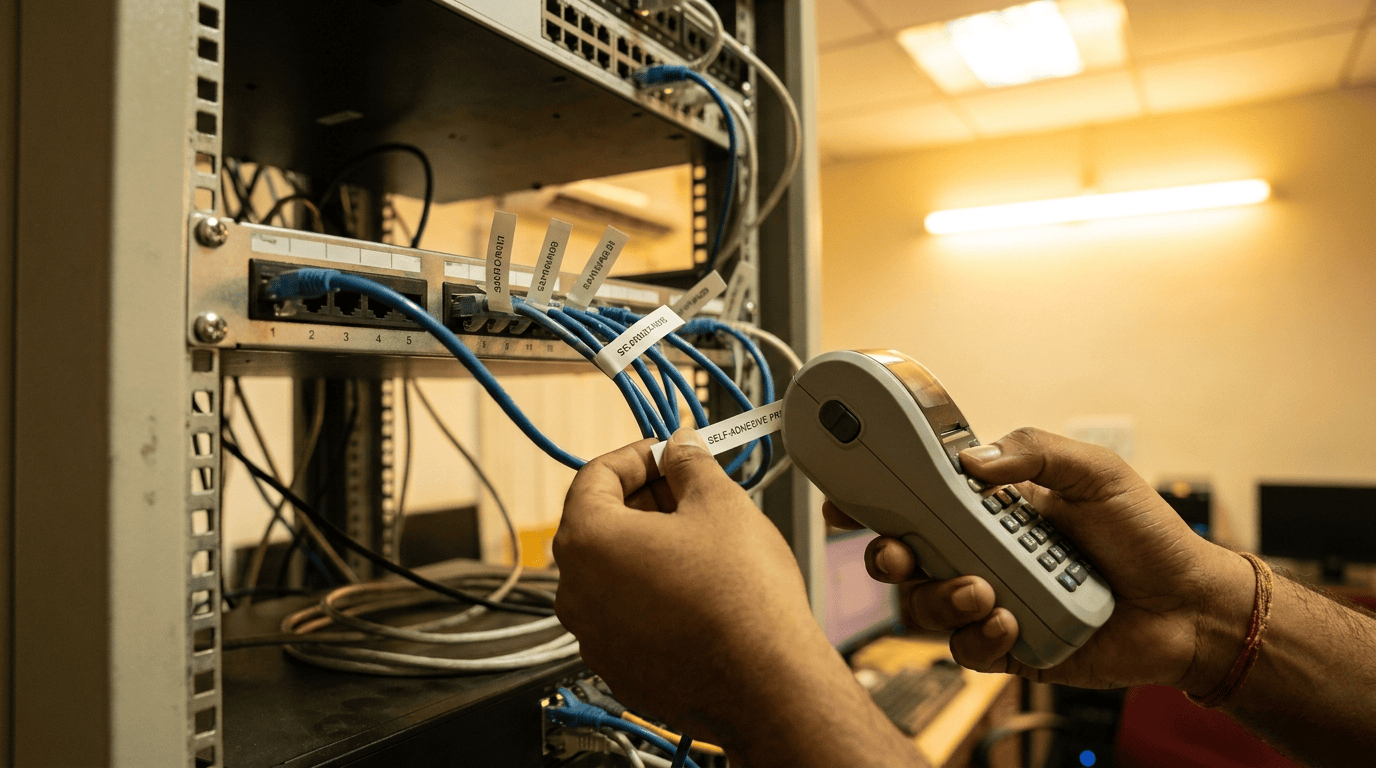
Labelling assets and cables that lasts
Labelling assets and cables is the job everyone skips and everyone regrets. A 220-person auto-components maker in Coimbatore found that out at 2am, when a single unlabelled patch cable turned a ten-minute fix into a four-hour outage. Here is what went wrong, and the labelling standard we left behind so it never happened again.
The cable nobody could name
The call came in just after 2am. A production-reporting server at a Coimbatore auto-components plant had dropped off the network, and the night shift could not log their output. Two hundred and twenty people. One factory that runs three shifts and bills by what those shifts produce. When the reporting stops, the invoicing questions start the next morning.
Their IT lead opened the rack and found the problem fast. A switch port had died. The fix was obvious. Move the server to a spare port and repatch. Simple, if you know which cable is which.
He did not. The rack was a nest of grey cables, and the labels were strips of masking tape with a marker scrawl that had baked hard and flaked in the plant heat. Half were blank. The other half read things like “server 2” in handwriting nobody could match to a machine anymore. So a ten-minute repatch became a four-hour session of unplugging, tracing, and praying. Arre. At 3am, in a hot room, that is a bad way to find out your labels never lasted.
Why the labels never stood a chance
We got the post-incident call the next week. When I walked the room, the story was written on every cable. Masking tape and marker in a data rack is a time bomb. The adhesive gives up in warm air, the ink fades, and within a year you are reading ghosts.
The asset side was no better. Machines had asset stickers from three different vendors, three different formats, and a good number had peeled clean off near the shop-floor doors where oil and heat do their work. The finance team kept an asset register in a spreadsheet. The spreadsheet and the shelves had stopped agreeing a long time ago.
None of this was laziness. Somebody had labelled all of it once, on the day it was installed, with whatever was in the drawer. The jugaad held for a demo and failed for the long run. That is the real trap with labelling. It looks done on day one and quietly rots until the night you actually need it.
200+ Indian businesses. 17+ years in IT business. Response within 24 working hours.
Labelling assets and cables that lasts
The fix is not clever. It is durable. Labelling assets and cables that lasts comes down to two choices most people get wrong: the material you print on, and the scheme you print.
Start with the material. A Brother P-touch industrial labeller prints on laminated TZe tape, where the ink sits between two layers of plastic. That lamination is the whole point. It shrugs off heat, oil, water, and the daily abrasion of a plant floor, so a port ID you print today is still readable in year three. Brother India rates that tape for a wide temperature range and years of outdoor and industrial life, and on a hot Coimbatore mezzanine that rating is not marketing, it is the difference between a fast fix and a bad night. For cables there are self-laminating wrap labels, where the printed part wraps the cable and a clear tail seals over it, so the text never rubs off against a bundle.
Then the scheme. A label is only useful if it says something you can act on. “Server 2” helps nobody. A good cable label names both ends: source device and port, destination device and port. A good asset label carries a fixed asset ID that matches the register, printed as text and, where it earns its keep, a barcode you can scan into your inventory. Print the same fields, the same way, every time. Bas. The consistency is what turns a label into a system.
What the material actually changes
People push back on the cost of laminated tape. It is a fair question, so here is the honest comparison we walked the plant through. This is not about a premium for its own sake. It is about what you are still able to read when it counts.
| Label approach | Holds up to heat and oil | Readable in year 3 | Best use |
|---|---|---|---|
| Masking tape and marker | No | Rarely | Nothing in a rack. Temporary desk notes only. |
| Paper sticker labels | Poorly | Sometimes | Cold, clean, low-touch offices |
| Laminated tape (Brother TZe) | Yes | Yes | Racks, plant floors, cables, asset tags |
| Self-laminating cable wrap | Yes | Yes | Both ends of every patch and power cable |
The plant did the sum themselves. One outage of the kind they had just lived through cost more in idle shift time than a labeller and a year of tape. After that the conversation was over.
200+ Indian businesses. 17+ years in IT business. Response within 24 working hours.
The asset register that finally matched the shelves
There is a second reason this matters, and it lands on the finance and compliance side. An asset that is tagged with a permanent ID, matched to a register, is an asset you can actually account for. When the DPDP Act pushes Indian firms to know where their data-carrying devices are, a shelf of laptops and drives with peeled stickers is a genuine problem. You cannot protect what you cannot find.
We re-tagged the plant’s IT and data assets with laminated labels carrying a clean ID and a barcode, and rebuilt the register against them in an afternoon. Now a stock check is a walk with a scanner, not a treasure hunt. The office manager got her afternoons back, and the auditor got a register that agreed with reality. If you want the naming to follow a recognised pattern rather than one you invent, the cabling world already has one. The Telecommunications Industry Association publishes ANSI/TIA-606, the administration standard for labelling telecom infrastructure, and it is a sane place to borrow a scheme from. The cabling body BICSI makes the same case for consistent, documented labelling in its installation guidance.
How we rolled it out without stopping the plant
You do not relabel a live server room in one heroic weekend. We did it in passes. First, one written naming scheme, agreed with their IT lead, so every label would say the same kind of thing. Second, the racks, both ends of every cable and every device, done rack by rack during quiet windows. Third, the asset tags across IT and data-bearing kit, tied back to the register.
The labeller lives in the server room now, with spare rolls of tape next to it, because the job is never truly finished. Every new switch, every new drive, gets labelled the day it is installed, to the same scheme. That last habit is the one that pays off. A standard that only exists in a document dies. A standard with a labeller sitting on the rack and a rule that nothing gets racked unlabelled, that one survives.
If you are standing up a new site or fleet, this is far cheaper to do at install than to retrofit after an outage. We wrote about the same discipline from a few other angles: why cost per page beats the sticker price when you buy any Brother device, how a laser and ink-tank split settled a design studio, and how standardising printers across branches cut a firm’s support load. The full Brother range, including P-touch labellers, sits on our Brother business printers India page.
Key takeaways
- Labelling assets and cables that lasts is a material choice first. Laminated tape survives heat and oil. Marker and paper do not.
- Name both ends of every cable and give every asset a fixed ID that matches your register.
- Keep the labeller on the rack and label new kit the day it arrives, or the standard rots.
- Durable asset tags are also a DPDP and audit win. You can only protect the devices you can find.
Questions Indian businesses ask about server-room labels
Why not just use a cheap label printer or masking tape?
In a clean, cool office, a basic label may last. In a rack or on a plant floor, heat and oil kill paper and marker within a year. Laminated tape is what keeps the label readable when you need it during an incident.
What should a cable label actually say?
Both ends. Source device and port, destination device and port, to one consistent format. A label that reads “server 2” is close to useless at 3am. One that reads the exact ports on each end pays for itself in a single outage.
Does labelling help with a DPDP or asset audit?
Yes. A permanent asset ID that matches your register means a stock check is a scan, not a hunt. You cannot account for or secure a data-bearing device you cannot reliably identify on the shelf.
Will Sirius Star just sell us the most hardware?
No. Often the honest answer is one labeller, the right tape, and a naming rule your own team can run. If a simpler fix works, we will tell you to your face.
200+ Indian businesses. 17+ years in IT business. Response within 24 working hours. Reach us on WhatsApp at +91 91375 93228, 10 to 7 IST.
P.S. Sudeep here. We ran this same relabelling for a Pune logistics firm last month. Their DR failover worked perfectly on paper and failed in the room, because nobody could trace the cables fast enough. A day of labelling fixed what a year of good intentions had not. If you want us to look at your rack before your next bad night, send a photo of it and we will tell you honestly what to fix first. Sometimes the answer is just better tape.
The longer read for Indian buyers who want the real numbers before they commit.
Send me the field guide