

NetApp ONTAP Storage India: A 60-Day BFSI Bake-Off That Forced Three Rethinks
TL;DR: A 1,400-employee Mumbai cooperative bank put NetApp AFF C250, Dell PowerStore 500T, and Hitachi VSP One B26 on the same 280 TB mixed workload for 60 days. NetApp ONTAP held a 4.3:1 effective data-reduction ratio on file shares and kept p99 read latency under 480 microseconds on the HANA log volume. PowerStore won the rebuild time test at 19 minutes for a failed 1.92 TB drive. VSP One won on the cleanest IOPS curve at 80% sustained utilisation.
This is the unedited story of a NetApp ONTAP storage India bake-off at a Mumbai cooperative bank. I had been into this back-office twice before, once for a Sophos refresh and once for a Cisco UCS rack-stack. The IT head, Manish, runs the place like a control room. Every alert has an owner. Every change has a back-out plan. When he called me in March about storage, the brief was unusual. He did not want a vendor recommendation. He wanted three boxes on his floor for two months and a clean spreadsheet at the end.
Why a Mumbai bank put three vendors on the floor
The estate then was a 5-year-old NetApp FAS 2750 plus an EMC Unity 380 that had aged out of support six months earlier. The audit had flagged the Unity. RBI had asked specifically about RPO and RTO for the SAP HANA payroll database and the loan-origination file store, which lived on different boxes for no reason anyone alive could explain. The board had cleared INR 2.5 crore. Manish wanted INR 1.8 to 2 crore on the array and the rest for a second-site DR appliance.
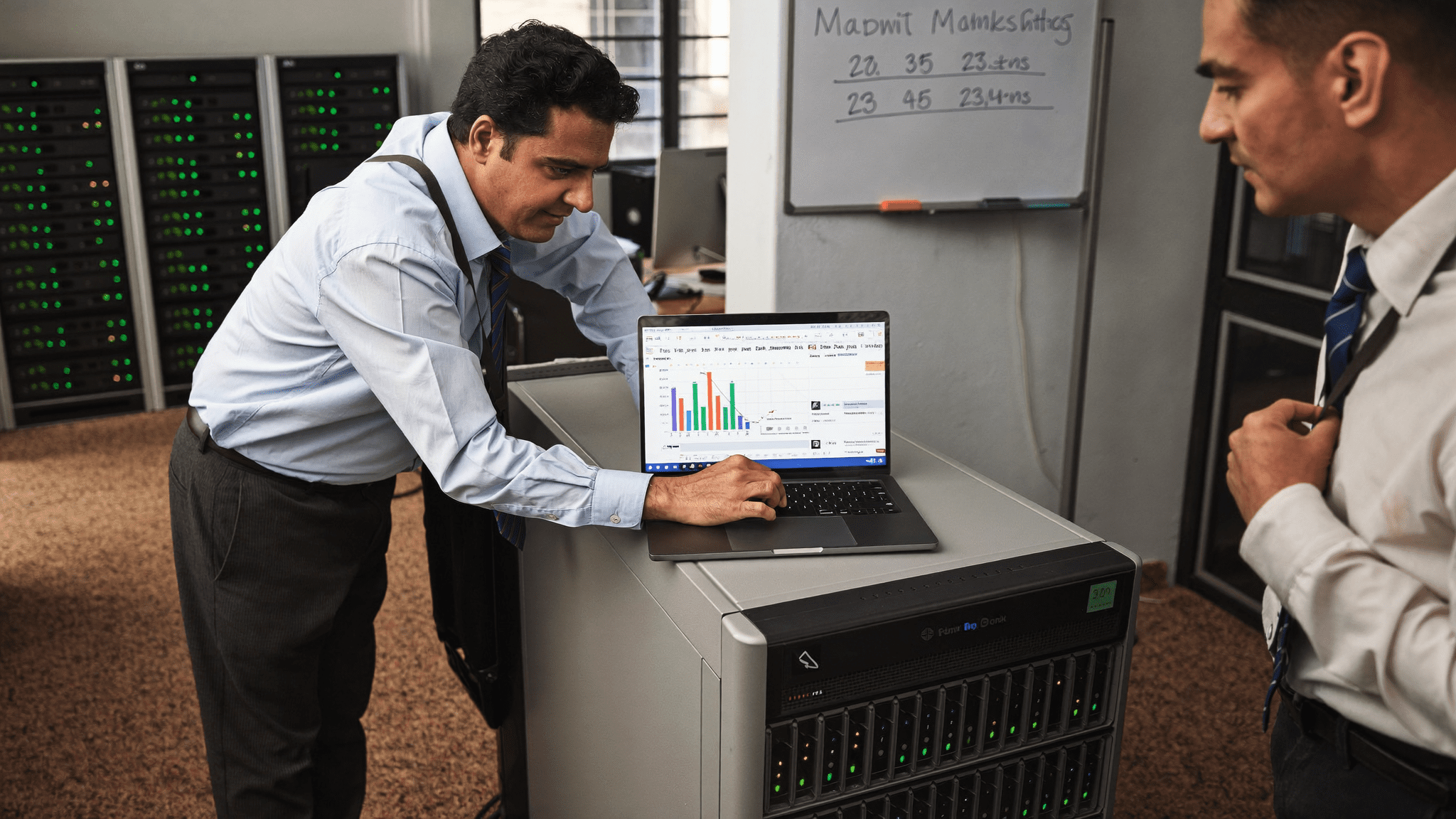
So we agreed on a 60-day bake-off. Three vendors, three loaner boxes, the same five workload tests, the same monitoring. NetApp shipped an AFF C250 with 48 TB raw of NVMe. Dell shipped a PowerStore 500T with 46 TB raw. Hitachi shipped a VSP One B26 with 51 TB raw. The bank’s pre-prod ran on each in turn, then all three were hit with synthetic loads that mirrored their busiest week of 2025.
What our NetApp ONTAP storage India bake-off actually measured
The five tests were not glamorous. SAP HANA log-volume write latency under a sustained 8,000 transactions per second. VMware VMFS datastore random 70/30 read/write at queue depth 32. File-share dedupe ratio across a 14 TB sample of the loan archive (lots of repeat PDFs, that mattered). Single-drive failure rebuild on each array at 70% utilisation. And a Saturday-night replication to a Hyderabad DR target, 1,489 kilometres of WAN with 22 ms RTT.
We measured everything in OnCommand Insight, vROps, and the vendor-native UIs at 30-second intervals. Manish’s lead engineer Aakash also ran a parallel Excel sheet on his laptop, because in his words, “vendor dashboards lie politely.” Achha, fair.
Get my free 4-hour NetApp ONTAP quote
200+ businesses served. Response within 24 working hours.
Where NetApp ONTAP won the day
Three things, in order of impact.
The file-share dedupe came in at 4.3:1 effective on the loan archive sample. PowerStore did 2.9:1 on the same data. VSP One reported 3.1:1. That meant for 280 TB of effective capacity, NetApp needed 65 TB of raw NVMe. The other two needed 96 and 90 respectively. That mattered for the bill of materials more than any single benchmark on a slide.
The HANA log-volume p99 read latency stayed under 480 microseconds across the test window. PowerStore floated between 510 and 580. VSP One was the cleanest of the three at 440, but only when we capped utilisation at 65%. NetApp held its number to 80%. Aakash’s spreadsheet noticed that, and so did Manish.
SnapMirror to the Hyderabad target appliance got the file workload to a 4-minute RPO on the 22 ms link. PowerStore Asynchronous Replication achieved 6 minutes. VSP’s HUR setup needed extra licensing we had not budgeted, a small jhamela that pushed the timeline by two weeks. The bank’s risk team had pegged RPO at 15 minutes for the loan store, so any of the three would have passed on paper. NetApp’s lead was operational, not pass-fail.
Where PowerStore and VSP One pushed back
This is the part I always tell buyers to read first.
PowerStore 500T finished a single-drive rebuild in 19 minutes at 70% utilisation. NetApp’s AFF C250 finished the same test in 27 minutes. VSP One took 24. None of these are slow, and ONTAP’s parity scrub is designed to back off when the workload spikes, so the gap reflects a deliberate trade-off. But if I were running a busier estate that lost drives twice a quarter, I would weight that 8-minute gap.
VSP One held the cleanest IOPS curve under sustained 80% utilisation. We ran a 6-hour soak at 70/30 read/write, and Hitachi’s controller stayed flatter than the other two. NetApp dipped 4% on the same test. PowerStore dipped 7%. If the bank’s pre-prod ever became the production again under load, this would have mattered. It did not, this time.
The honest summary is that all three boxes would have done the job. None of them embarrassed themselves. The differentiation was at the edges, and the edges came down to data reduction on this specific data set, replication ergonomics on this specific WAN, and how each vendor handled the future-state cloud path.
Book my 4-hour storage discovery call
17 years in Indian IT. 200+ businesses served.
The decision, the price, and the lesson I keep
The bank signed NetApp at INR 1.84 crore including 3-year SupportEdge Premium, the ONTAP file services bundle, SnapMirror plus 32 TB of replication capacity on a second AFF C190 in Hyderabad, and ONTAP Cloud Volumes credits for Azure India South that they intend to test for HANA archive in 2027. The Dell quote came in at INR 1.96 crore for equivalent effective capacity. The Hitachi quote, after the HUR licensing surprise and a 10G card upgrade Manish wanted, landed at INR 2.11 crore. The DR-site sizing reads directly from the RBI Master Direction on Outsourcing of IT Services and the bank’s own ITGC audit memo from January, per source: Manish.
Here is the rethink I owe Manish. I had priced NetApp on raw TB in week one. I had drawn an INR-per-TB column based on the 48 TB raw NVMe figure. Aakash, who has lived with FAS systems for nine years, walked over with his laptop and said, “bas, you are looking at the wrong number.” We rebuilt the math on effective capacity using a conservative 3.6:1 ratio, not the test’s 4.3:1, and the gap closed by INR 28 lakh. The bank still wrote the smaller cheque, but my opening pitch had been wrong, and Manish noticed. The lesson stays with me. Arre, on file-heavy workloads in India, dedupe and compression numbers are the line item, not the raw drive count.
The second rethink was about cloud paths. I had not given enough weight to Cloud Volumes ONTAP early in the cycle. Many Indian BFSI customers still treat cloud as an option for 2028. Manish treats it as a Q3 2026 board conversation. ONTAP gave him a credible “we already speak the language” line for that meeting, with the same SnapMirror DNA reaching into Azure India South. PowerStore has a path via PowerProtect. VSP One has Hitachi’s cloud connector. Both work. The ONTAP route was just shorter for his Excel sheet.
The third rethink was about the support model. Manish asked each vendor for a real Mumbai engineer name, a phone number, and a P1 response time written into the contract. NetApp put a senior storage engineer based in Andheri on the SOW within a week. Dell offered ProSupport Plus with a Bangalore-routed escalation desk. Hitachi offered remote-first with on-site within 24 working hours. For a cooperative bank with 11 branches across Maharashtra, the local-name commitment closed the room.
| Test | NetApp AFF C250 | Dell PowerStore 500T | Hitachi VSP One B26 |
|---|---|---|---|
| HANA log p99 read latency | 480 microseconds at 80% util | 510 to 580 at 70% util | 440 at 65% util |
| File dedupe ratio (loan archive sample) | 4.3:1 effective | 2.9:1 effective | 3.1:1 effective |
| 1.92 TB drive rebuild at 70% util | 27 minutes | 19 minutes | 24 minutes |
| Replication RPO on 22 ms WAN | 4 minutes (SnapMirror) | 6 minutes (PowerStore Async) | 8 minutes plus HUR licence |
| 3-year all-in INR per effective TB | INR 65,700 | INR 73,000 | INR 79,300 |
Key takeaways
- For Indian BFSI estates that lean file-heavy, NetApp ONTAP’s data reduction is usually the line item that decides the deal.
- The only honest dedupe comparison is the one run against your data, not the vendor’s. Run the sample.
- Replication tooling and DR-link economics matter more than any single benchmark in a 60-day evaluation.
- Local engineer commitments belong in the SOW, not in the slide deck.
FAQ
Does NetApp ONTAP storage in India work for hybrid cloud strategies?
Yes. ONTAP runs the same data fabric on-prem on AFF and FAS, in colocation, and in Azure India South or AWS Mumbai through Cloud Volumes ONTAP. SnapMirror keeps the policy consistent across all three. Most Indian customers I speak to use ONTAP on-prem as the primary, with cloud as a tier-3 archive target. For DPDP compliance, the on-prem residency is the easier conversation.
How does NetApp AFF compare to Dell PowerStore for SAP HANA in India?
In our 60-day Mumbai bake-off, NetApp AFF C250 held p99 read latency under 480 microseconds at 80% utilisation. PowerStore was in the 510 to 580 range at 70%. Both clear SAP’s certification floor for HANA. The differentiation came on data reduction (NetApp 4.3:1 versus PowerStore 2.9:1 on the same file sample) and replication ergonomics over the 22 ms WAN.
What is the typical INR pricing for a 280 TB NetApp ONTAP deployment?
For a BFSI use case with 3-year SupportEdge Premium, file services bundle, SnapMirror, plus a smaller DR target appliance, INR 1.7 to 2 crore is the band we see for 280 TB effective capacity. Raw drive count, NVMe versus SAS choices, and dedupe-ratio assumptions shift the number. Always price on effective TB, not raw TB.
Is NetApp StorageGRID a better fit than ONTAP for object storage in India?
StorageGRID is the object-first platform and fits CCTV footage retention, application object stores, and regulated long-term archives that need S3 semantics. ONTAP handles unified file plus block. Some Indian customers run both, with StorageGRID as the long-tail archive target behind Commvault or AvePoint policy. The control mapping we usually draft to walk auditors through this sits squarely inside ISO/IEC 27001 Annex A.8 and the storage-specific A.5.34 retention clause. If your workload is file plus HANA plus VMware, ONTAP is usually the simpler answer.
Talk to my NetApp engineer in 4 hours
17 years in Indian IT. We have shipped this for 200+ businesses.
The longer read for Indian buyers who want the real numbers before they commit.
Send me the field guideP.S. Sudeep here. The team has run this exact bake-off in three other Indian cities and the answer is never the same. A Pune manufacturer picked Hitachi last year because their data set deduped poorly. A Chennai NBFC chose PowerStore on rebuild times. The trick is to run your own data, your own way. If you want the spreadsheet template Aakash used, reply on WhatsApp and I will send it across, yaar.
Related reading from our team: AvePoint Cloud Backup Tuesday recovery in Hyderabad, Acronis Cyber Protect bake-off in Coimbatore, APC Smart-UPS Andheri Friday outage, Okta SSO rollout at a Pune NBFC.