Single phase or three phase UPS for server room: a Mumbai branch bake-off
I get this question about twice a week. A branch manager, or a facility head, or the IT lead of a mid-sized SaaS firm sends the same note. Server room is being redone. Electrical contractor is asking whether the new BPE UPS should be single phase or three phase UPS for server room use, at a 12 kW load. Budget is close either way. Which one actually helps.
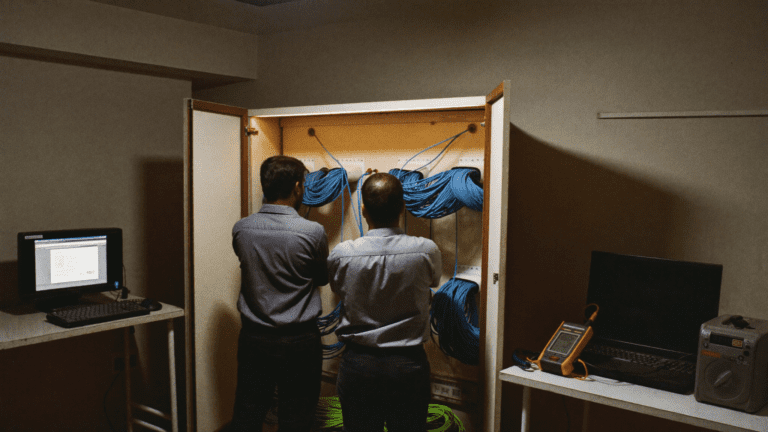
Last year we ran the test. Two branches of the same regional bank in Maharashtra. Same load profile. Same server stack. Same contractor. Different UPS choice. Six months of data. Here is what happened.
What the two branches looked like on paper
Both branches had a 12 kW connected IT load. Dual-corded rack servers, two Cisco Catalyst switches, a small NAS, one AV rack, and about eleven desktops on the office floor drawing from the same UPS bus. Sanctioned load from MSEDCL was 25 kW at each site, so both had a proper 3-phase incomer. That is where the paths split.
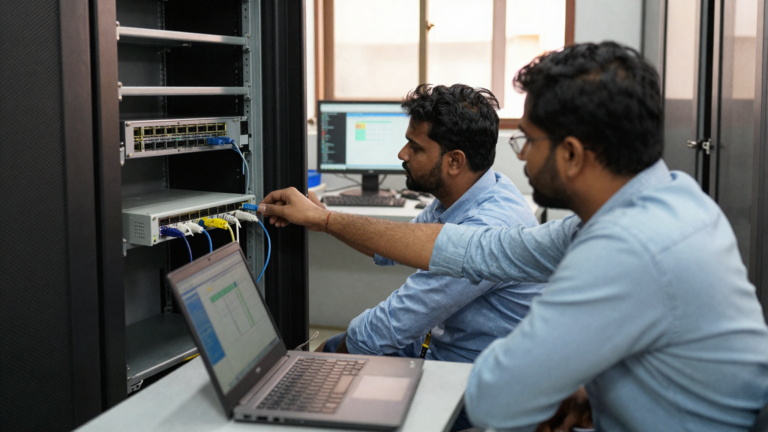
Branch A went with a 20 kVA BPE 3-phase online UPS, 3/3 configuration, one external maintenance bypass switch, one battery cabinet, one point of monitoring.
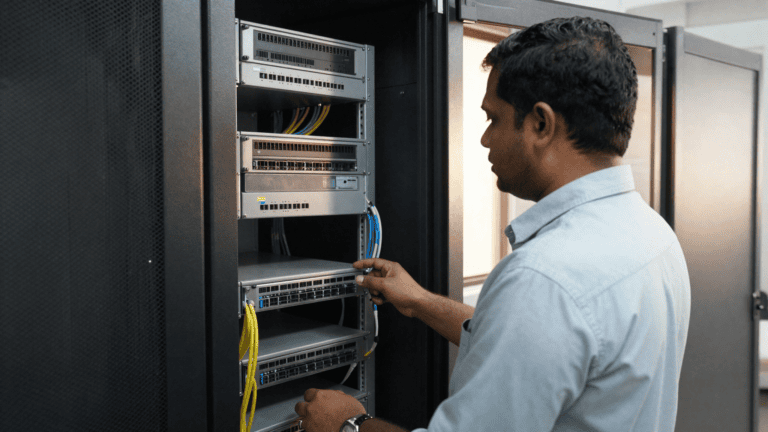
Branch B went with three 6 kVA BPE single-phase online units, 1/1 configuration, one on each incoming phase, split across three separate DB feeders on the office side. Three battery banks, three monitoring cards, three change-over paths.
The electrical contractor liked B. Simpler install, cheaper cabling on each leg, no phase-balance drama, and if one unit died the other two would keep two-thirds of the load alive. The bank’s Central IT liked A. One asset, one AMC, one dashboard. Both are defensible on a whiteboard.
Total capex was within 8% of each other. Landed cost, including cabling, DB rework, and external bypass, came to ₹6,90,000 for A and ₹7,40,000 for B, once you counted three sets of batteries. The Schneider guidance on 1-phase vs 3-phase thresholds put both branches in the grey zone the industry rarely writes about.
The Wednesday that decided it
Third week of August. Big monsoon spell in Thane. MSEDCL feeder dipped hard around 3.10 pm. Voltage on Phase Y sagged to 168 V for about 40 seconds before the whole feeder tripped. Genset picked up at both branches.
At Branch A, the 3-phase UPS saw the Y-leg sag, corrected internally by drawing more current on the two healthy legs while the inverter compensated the output waveform, and rode through. No transfer to battery. Servers never noticed. When the DG came on, the UPS synced clean because it was one asset seeing one waveform-set.
At Branch B, the single-phase unit on Phase Y transferred to battery immediately, correctly. Its siblings on R and B stayed on mains. When the DG came on 22 seconds later, the R and B units synced fine, and the Y unit tried to sync from battery back to DG. The DG frequency was 51.4 Hz and drifting, because DGs always take a moment to settle. The Y unit rejected the sync window and stayed on battery for the full 4 minutes it took the DG to trim. Battery took a bruising. Nothing failed. But the unit needed a service call two months later.
What the scoreboard said after six months
Here is the honest breakdown.
| Category | Branch A · 3-phase | Branch B · 3× single-phase |
|---|---|---|
| Total install cost | ₹6,90,000 | ₹7,40,000 |
| Battery cycles used (6 mo) | 18 | 34 |
| Service calls | 2 (scheduled) | 4 (1 scheduled, 3 issue) |
| Monitoring points | 1 | 3 |
| Phase imbalance issues | 0 | 2 (both resolved) |
| Uptime impact events | 0 | 0 |
| Space in electrical room | 1 cabinet | 3 cabinets |
Uptime was the same. Both branches held. Branch B worked harder to get there.
Get my free 4-hour BPE UPS sizing check
When single phase still makes sense
This is not a piece where the fancy answer wins. Single phase UPS is the correct call more often than the vendor deck suggests.
If your server room draws under 8 kW today and your business has no plan to add more racks, more OT-style equipment, or a second NAS in the next 24 months, do not buy three-phase. You are paying for headroom you will not use. The BPE 6 kVA online single phase runs a small SaaS office comfortably, needs one wall socket rated at 32A hardwired, and the AMC is simpler because the field team sees hundreds of them every month.
Naveen, who runs our networking desk, put it this way to a Pune startup last week. “You have four servers and a firewall. Three-phase for that is a scooter with a Bullet engine. Nothing wrong. Just why.”
The other case where single phase wins is a distributed office. If your loads are physically spread across three floors and you cannot pull one clean UPS bus, three smaller units close to each load beat one big centralised unit. That is not a phase question. That is a topology question.
When three phase pays back inside 24 months
The threshold in Indian conditions is not the textbook 10 kVA the Eaton buying guide quotes. It is closer to 12 kW of steady load with any DG in the picture. Once you cross that, a 3-phase UPS earns its landed price back in three ways.
First, DG sync. A single 3-phase unit sees one composite waveform and rides through a bumpy DG cutover. Three single-phase units each make their own decision. On a bad monsoon Wednesday, they will not all make the same one.
Second, cable and DB. A 30 kVA 3-phase draw pulls about 43 A per phase. The same 30 kVA on a single phase 1/1 install pulls 130 A on one leg. That is a different cable, a different MCB, and often a different DB rework. The electrical contractor’s quote for the DB side alone can swing ₹80,000.
Third, service. One asset, one AMC, one dashboard. When something goes wrong at 11 pm on a Saturday, you make one call, not three. Sirius has done this for 200-plus Indian businesses over the last decade. Every single one of the multi-unit sites had one story about the 11 pm Saturday.
The middle case, and the honest answer for it
Between 8 and 12 kW is the grey zone. Bas, this is where the debate really lives.
Our rule now, after Branch A and Branch B, is this. If you have a 3-phase incomer already (most Indian offices with sanctioned load over 7 kW do), and you have any DG or plan to add one, go 3-phase UPS even at 10 kW. The waveform-sync behaviour alone is worth the delta. If you have single-phase incomer only, and no DG, three separate single-phase units are fine.
What you should not do is size for today. Servers grow. GPUs grow. That one AV rack becomes two. The BPE 15 kVA 3-phase gives you 30% headroom for four years of growth. The three 6 kVA single-phase units give you zero headroom the day you install them.
What the BPE range does well, and where it does not
We ship BPE because it is India-made, landed price is 30 to 35% below the imported alternatives at the 10 to 30 kVA range, and the service network is the tightest in the country for that band. The 3-phase online in the SUB-K and BR series will hold PF 1.0 output and IGBT rectifier efficiency in the 94 to 96% range at typical loading. That is good work at that price.
Where BPE is not the answer is above 60 kVA in a Tier III data centre with N+1 requirements. That is Schneider Galaxy VS or Vertiv Liebert territory, and we quote those when the brief needs them. Being honest about that is part of the pitch.
Talk to us about your server room load profile
How to run the decision in your own head
Three questions. Answer them in this order.
One, what is your steady load today plus 30% for 24 months of growth? If under 8 kW, single phase. If over 12 kW, 3-phase. If in between, question two matters.
Two, do you have a 3-phase incomer with a DG? If yes, 3-phase UPS. If single-phase incomer and no DG, single-phase units are fine.
Three, is your load physically centralised or distributed across floors? Centralised means 3-phase pays. Distributed means three smaller single-phase units, one per zone, often makes more sense than one big centralised UPS with long cable runs.
That is the whole rulebook. Anything more elaborate is a vendor trying to close a bigger asset.
What we would do if this were our own office
Sirius runs a 3-phase BPE online UPS in our own Mumbai office. 15 kVA, N+0 for now, external maintenance bypass, VRLA bank sized for 15 minutes at full load with an AMC that changes cells every three years whether they need it or not. We chose it because we run a modest DG and monsoon in Bandra is what monsoon in Bandra is. If you asked me to redo it today, I would size the same and add a small lithium extension for the next refresh. That is a different blog.
Common questions we get on this
My electrician says three single-phase units will be cheaper. Is he wrong?
Not always. On pure hardware capex, three 6 kVA units can be ₹40,000 to ₹80,000 cheaper than one 15 kVA 3-phase, at list price. Once you add three battery banks, three monitoring cards, and three service contracts, the delta closes fast. The Y-phase Wednesday story is the extra tax that does not show up in the quote.
What size UPS do I need for four dual-corded servers?
Rough rule for planning: dual-corded servers count as 1.4x their nameplate for UPS sizing because you have to power both cords through the UPS bus. Four servers at 500W nameplate each gives you 2.8 kW just for the servers, so budget 5 kW total to include switches, NAS, and headroom. Sizing details in our UPS sizing guide for Indian offices.
Modular UPS or standalone?
Different question. Modular is about future scaling and hot-swap of failed modules, and it is worth the premium above 30 kVA. Below that, standalone wins on price. We wrote about the crossover in when a modular UPS makes sense.
Lithium or VRLA batteries?
Straight cash question. VRLA is cheaper on day one and expensive over 8 years. Lithium is expensive on day one and cheap over 8 years. If you plan to keep the UPS for a full 8 to 10 year cycle, lithium pays. If you refresh at 4 to 5 years, VRLA still wins. See our lithium vs VRLA breakdown.
What about 5-year total cost, not just capex?
The 5-year TCO comparison for online UPS batteries in Indian conditions is worked out here. For a deeper technical read on the input-output configurations, the Riello reference on 1/1, 3/1 and 3/3 topologies is a clean primer.
The one thing your vendor will not tell you
A 3-phase UPS is not automatically better. It is better in specific Indian conditions. DG in the picture, load above 12 kW, centralised topology, 3-phase incomer already sanctioned. If you are missing any two of those, single phase is the sane call. Anyone quoting you three-phase for a 6 kW load with no DG is selling you a story, not sizing your room.
We have said no to about ₹40 lakh of business over the last two years by telling people to buy the smaller unit. Nobody has come back angry about it.
Get a straight sizing check on your server room
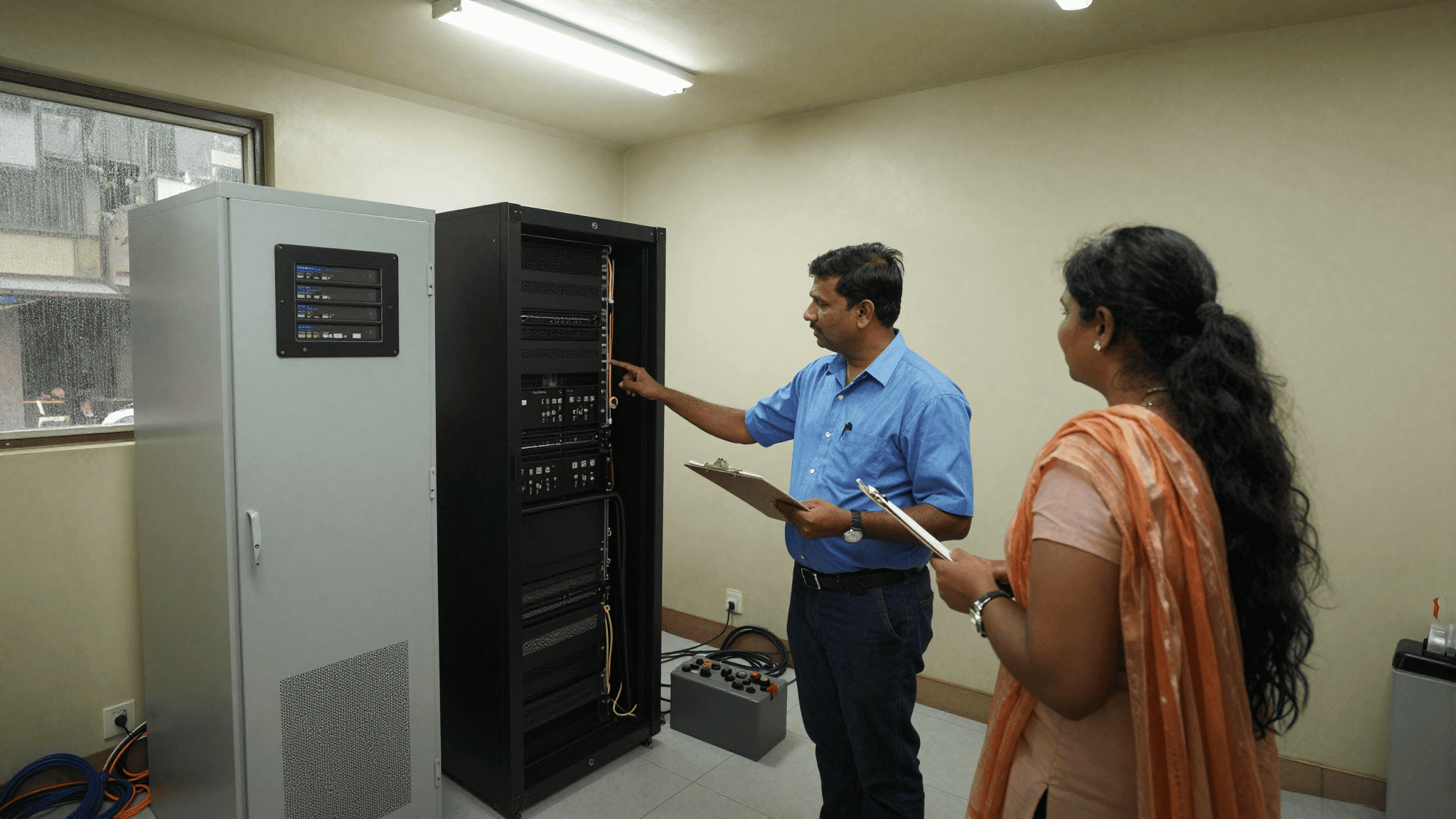
We will send an engineer to look at your incomer, your load, and your growth plan, and quote the right unit. Free, no card, no contract, no sales call.
Get my free BPE UPS sizing check
P.S. Riya here. If your electrical contractor is pushing you toward three single-phase units because it is what he installed last time, get a second look before you sign. Two of the three service calls at Branch B were preventable with a slightly different install. That is not a UPS problem. That is a topology problem, and it is fixable if you cat The longer read for Indian buyers who want the real numbers before they commit.