How to size your UPS without overbuying
TL;DR
- A 180-person auto-components plant near Coimbatore was about to buy a 20 kVA online UPS for a server room pulling 6 kW. The vendor had quoted big and called it safe.
- We put a meter on the rack for a working week. The real load never crossed 7 kW. A 10 kVA unit covered it with room to grow.
- Oversizing is not free insurance. A big online UPS running at 30 percent load burns more on the bill, carries a battery bank you pay for and barely use, and still ages on the same clock.
- The honest catch: undersizing is worse. The trick is a measured load, an 8 to 10 minute runtime target, and a unit you load to roughly 60 to 75 percent. Not the biggest box in the catalogue.
By Riya Kapoor, Hardware Practice. 29 Jun 2026. About 7 min read.

A UPS quote under a paperweight, and one meter that changed the number.
The quote was sitting under a paperweight shaped like a brake disc. 20 kVA, online double-conversion, about 3.9 lakh. Deepak ran IT and admin for an auto-components maker outside Coimbatore, 180 people across the plant and the office block. He slid the paper across and asked me one thing. “Is this enough?” Arre, that was the wrong question, and I told him so over thanda chai.
The right question was the opposite of his. Not is it enough. Is it far too much. A vendor had walked the floor for ten minutes, looked at the rack, and reached for a round number with plenty of headroom. Headroom feels like safety. On an online UPS it is often just a bigger bill with a battery bank attached. This is the story of the week we spent measuring before we spent his money.
Why bigger feels safe and bills you anyway
Here is what the catalogue does not lead with. An online UPS is most efficient inside a load band, usually somewhere from half to three-quarters of its rated capacity. Run it far below that band and the efficiency curve sags. The unit still draws to keep its inverter and rectifier alive, so a 20 kVA box minding a 6 kW load wastes a slice of power every hour of every day for years.
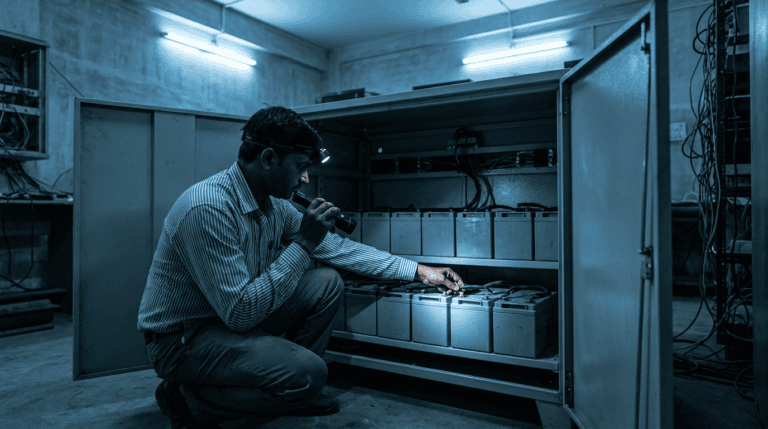
Then there is the battery. A 20 kVA unit ships with a battery bank built for 20 kVA of backup. Deepak would pay for that bank up front, and pay again when it needed replacing, whether or not he ever pulled near that load. He would buy backup capacity he had no use for, and replace it on the same calendar a smaller bank would have followed. Bas, that is two costs stacked on a benefit he could not spend.
Floor space and heat finish the case. A bigger UPS is a bigger cabinet throwing more warm air into a room that, this being a plant near Coimbatore, already touched 33 degrees by mid-afternoon. Heat shortens battery life. So the oversized box quietly works against the very thing it was sold to protect.
How to size your UPS for a real server room load
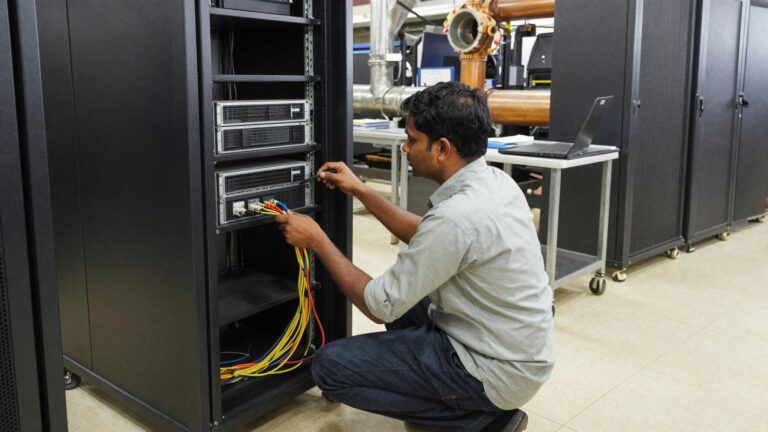
You do not size a UPS off a nameplate. You size it off a meter. We clamped a power meter on the rack feed and left it for a full working week, plant running, office running, the lot. That one step is the whole game, and it is the step most buyers skip because the vendor number arrives first and feels official.
Four inputs decide the answer. Measure the real load in kW, not the sum of every nameplate sticker, which always reads high. Pick the runtime you actually need before the diesel set takes over, for most branches and small server rooms that is 8 to 12 minutes, not an hour. Add honest growth headroom, say two years of it, not a decade. Then choose a unit you will load to roughly 60 to 75 percent, so it sits inside its efficient band with somewhere to climb.
Deepak’s rack pulled a steady 5.8 kW, peaking near 6.6 kW when the backup job and the air handler kicked together. Add two years of growth and call it 7.5 kW of design load. A 10 kVA online UPS gives roughly 8 to 9 kW of usable output depending on power factor, which put his real load at about 70 to 75 percent of capacity. Pakka inside the band. The 20 kVA unit would have run him near 30 percent, idling in the inefficient basement of its own curve.
17+ years in IT, 200+ Indian businesses. Response within 24 working hours. No card, no contract.
The number we built, box against box
Numbers move a plant manager more than opinions do. So we wrote both options on one sheet and let them argue. Same rack, same runtime target, same room.
| Sizing a server room UPS, 6 kW measured load | Vendor 20 kVA online | Right-sized 10 kVA online |
|---|---|---|
| Real load as percent of capacity | ~30 percent, below efficient band | ~70 percent, inside band |
| Upfront (UPS + battery bank) | ~INR 3.9 lakh | ~INR 2.4 lakh |
| Battery bank you actually use | A fraction of it | Most of it |
| Standby and conversion waste | Higher, every hour | Lower |
| Cabinet footprint and heat output | Larger, warmer room | Smaller |
| Runtime on the load that matters | Similar, sized to need | Similar, sized to need |
Read the top row, then the bottom. The expensive box did not buy Deepak more uptime on the load he had. It bought him a worse efficiency point, a battery he would not use, and a hotter cabinet. The runtime he needed, the 8 to 10 minutes to ride a cut and hand to the genset, both units delivered once we sized the battery to that number rather than to the chassis.
Where headroom is worth paying for
I came into this sure the line was always “buy smaller, save money.” The plant floor made me slow down. There are rooms where headroom earns its keep, and a buyer who right-sizes blindly can undersize into a different problem.
If a load is about to grow, a new production line, a second rack, a manufacturing-execution system going live next quarter, then sizing to today is a false saving. You will outgrow the unit and buy twice. The fix is not a 20 kVA guess. It is asking what the load will be in two years and sizing the UPS to land at 60 to 75 percent of capacity on that number, not on a wish. Sometimes that means 15 kVA, sometimes 10. The maths decides, not the fear.
Undersizing has the sharper teeth of the two. Push an online UPS past its rating and it bypasses to raw mains under overload, which is the exact moment you wanted protection. So the rule is not “small.” The rule is “measured, with two years of real growth, loaded inside the band.” That gives you a unit that runs efficient today and still has somewhere to go. The sizing bands for the units we fit sit on our APC online UPS India page.
The standards a buyer can stand on
One more thing for the file, because a plant gets audited too. Sizing to a measured load is not just a budget call, it maps to how efficiency and battery practice are written down. The energy-efficiency framing for equipment in India sits with the Bureau of Energy Efficiency, and an idling oversized UPS is a standing efficiency loss it would flag. The stationary battery standards for this kind of install are published by the Bureau of Indian Standards, and the maintenance and sizing practice for the bank maps to stationary battery guidance from bodies like the IEEE. None of that rewards a bigger box. All of it rewards the right one, loaded and maintained on a schedule.
That is what we fold into the install. A measured load on record, a battery sized to the runtime not the chassis, and a unit running where its own datasheet says it runs best.
What Deepak did, and what the floor said
He bought the 10 kVA unit. Six months on I asked the plant supervisor, the man who actually stands near the server room door, whether anything had changed since the cutover. He thought about it and said the line I keep. “I did not notice anything, madam. It just runs.” That is the receptionist test for power. The best UPS is the one the floor never has a reason to name, sized so it works quietly and costs only what the load is worth.
If you want to see the same maths run for the whole life of the box, our online UPS battery TCO over five years story walks the battery cost a sticker hides. For a bigger rack pod where the sizing call gets harder, the Schneider Galaxy versus Vertiv Liebert story runs the same maths, and the wider hardware practice sits on our IT hardware solutions page.
Key takeaways
- Size a UPS off a metered load over a real working week, not off the sum of nameplate ratings, which always reads high.
- Aim to load the unit to roughly 60 to 75 percent of its rated capacity, so it sits inside its efficient band with room to grow.
- Oversizing is a recurring cost, not free safety. You pay for wasted power, a battery you barely use, and a hotter room that ages the bank faster.
- Set runtime by need, usually 8 to 12 minutes to ride a cut and hand to the genset, and size the battery to that number, not to the chassis.
- Headroom is worth paying for only when the load is genuinely about to grow. Size to a real two-year number, not to a round one.
FAQ
How do I size a UPS for a server room in India?
Clamp a power meter on the rack feed for a full working week and read the real load in kW. Pick the runtime you need before the diesel set takes over, usually 8 to 12 minutes. Add two years of honest growth, then choose a unit you will load to about 60 to 75 percent of its rated capacity.
What load percentage should an online UPS run at?
Around 60 to 75 percent of rated capacity is the comfortable band for most online double-conversion units. That keeps the unit inside its efficient range with headroom for growth. Far below that, say 30 percent, wastes power and means you bought a battery bank you will not use.
Is it bad to oversize a UPS?
Yes, in most cases. An oversized online UPS runs below its efficient band, carries a larger battery bank you pay for twice and barely use, and throws more heat into the room, which shortens battery life. Right-sizing to a measured load is cheaper to buy and cheaper to run.
Can a UPS be too small?
It can, and that is the worse error. Push an online UPS past its rating and it drops to bypass under overload, leaving the load on raw mains when you needed protection most. Size to a real two-year load, not to today only.
Want a UPS sized off your real load, not a guess?
Sirius Star Enterprise Technologies. 200+ Indian businesses. No card, no contract, no sales call to start.
P.S. Riya here. I walked into Deepak’s office expecting to nod at the quote, and the meter made me hand it back. The advice worth taking is the kind where the person giving it has nothing riding on which box you pick. If you have a UPS quote on your desk right now, send us the kVA on the quote and, more importantly, the real measured load on your rack in kW. I will tell you whether the number is right-sized or just rounded up, with no brand loyalty in the room. Start the conversation on the form above, or email care@siriusstar.in.
The longer read for Indian buyers who want the real numbers before they commit.