
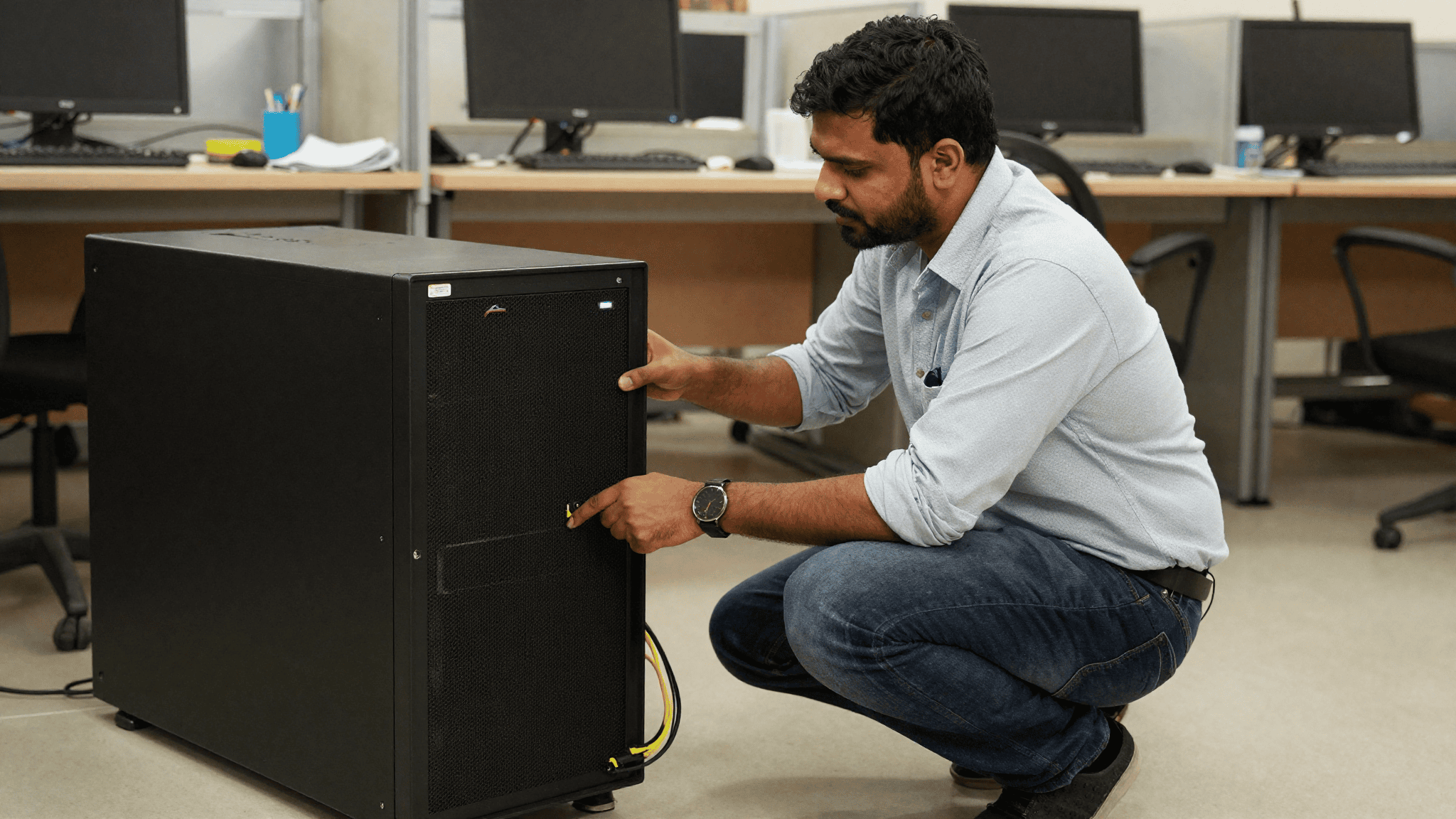
Sizing a UPS for an Indian office
The UPS at the reception of a 55-seat office in Coimbatore was the size of a small fridge and about as loved. Nobody looked at it for two years. Then one Friday at month-end it started beeping, the reception lights flickered, and forty people on the floor found out at the same moment what the box was for. The accounts team lost an hour of unsaved work. The office manager called me that evening. Her first line was the one I hear most. Arre, we did buy a UPS, so why did this happen. The answer was not the brand. It was the sizing.
The Friday the UPS gave up at desk 40
Here is what had happened. The office had grown from 20 desks to 55 over three years. Two more air conditioners went in. A small server and a network rack moved into a side room. Nobody went back to the UPS and asked whether the box bought for 20 desks could still carry 55 desks plus the new load. So on a hot Friday, with everything running and the grid dipping the way it does in that part of the city, the UPS hit its limit and did the one thing it is built to do when overloaded. It protected itself and dropped the load.
The machine was not faulty. It was honest. It was carrying more than it was ever rated for, and it told everyone so in the loudest way it had. This is the quiet failure mode of most office power setups. Nothing is broken. The office simply outgrew a number that nobody was tracking.
What sizing a UPS for an Indian office actually involves
Sizing a UPS for an Indian office is not a guess, and not a bigger-is-better shopping trip. It is three numbers, worked out in order, each one depending on the last.
First, the load. You add up what the UPS has to carry, in watts, with everything switched on at once. Computers, monitors, the server, the network rack, the routers, the desk phones. In most Indian offices the heavy air conditioning stays on the raw mains, not the UPS, because cooling a room off a battery makes no sense. So the load you protect is the IT and the lights, not the whole floor. Getting this list honest is most of the work. The Coimbatore office had never written it down.
Second, the kVA. UPS units are rated in kVA, not watts, and the two are not the same number. A UPS sold as 6 kVA does not give you 6,000 watts. It gives you the kVA times a power factor, and on older units that factor can be as low as 0.8, so a 6 kVA box carries about 4,800 watts of real load. Modern online units run closer to 0.9 or 1.0. This one gap is why so many offices buy a UPS that looks big enough on the sticker and trips under real load. You size the kVA to cover your watts with headroom, not to match them exactly.
Third, the runtime. A UPS is not a generator. It is the bridge that keeps the floor up either until the power returns, until the diesel set starts, or until you can save and shut down cleanly. Ten minutes covers most short city dips. Thirty minutes buys a calm shutdown of a server room. An hour usually means you are asking a battery to do a generator’s job, which gets expensive fast. Pick the runtime for what actually sits downstream, then size the battery to it.
200+ Indian businesses served. Response within 8 hours. No card, no contract, no sales call.
Single-phase or three-phase, the question nobody asked
The Coimbatore office had a second problem hiding under the first. Their incoming supply was three-phase, the way most commercial premises in India are wired once they cross a certain load. The old UPS was single-phase. So the whole IT load, plus a chunk of the lighting, was being pulled off one of the three phases while the other two carried the air conditioning and the rest. That phase was doing more than its share, and on a bad day it showed.
The rule of thumb is simpler than the wiring makes it look. Small offices with a modest IT load, say up to about 8 to 10 kVA, sit fine on a single-phase UPS. Once you are past that, or once you have a real server room and a three-phase connection, a three-phase UPS balances the draw across all three lines the way the building was designed for. It is not about being fancier. It is about not loading one phase like a mule while the other two idle.
If you are not sure which supply you have, the meter box tells you at a glance. Ask before you buy, because a single-phase UPS on a growing three-phase floor is a decision you pay for later, not at purchase. Our note on power resilience for BFSI branches walks through how regulated offices document this, and the logic holds for any growing floor.
kVA, watts and the runtime you actually need
Here is the shape of it for three common office sizes. Treat these as starting points for a proper load audit, not as a quote.
| Office profile | Protected load | UPS to look at | Phase |
|---|---|---|---|
| 15 to 20 desks, no server | Around 2 to 3 kW | 3 to 5 kVA online | Single-phase |
| 50 to 60 desks, small server room | Around 5 to 7 kW | 8 to 10 kVA online | Single or three-phase |
| 100 plus desks, real server room | 10 kW and up | 15 kVA and above | Three-phase |
Notice the Coimbatore office sat squarely in the middle row, on a box built for the top of the first. That is a two-size miss, and it explains the Friday perfectly. The gap between what they had and what they needed was not a rounding error. It was a different machine.
There is a longer-run number too. An undersized UPS runs its batteries hot, and hot batteries die young, so the office that buys small often pays twice, once in downtime and again in an early battery change. We laid the full five-year picture out in this UPS battery total cost of ownership piece. The short version: the right size on day one is usually the cheaper number by year three.
200+ Indian businesses served. Response within 8 hours.
Why the right-sized unit ended the Friday panic
We did the boring thing first. We walked the floor and wrote down the real load with everything on. It came to a shade under 6 kW once we left the air conditioning on the mains where it belonged. That pointed at a 10 kVA online unit, three-phase to match the incoming supply, with a battery bank sized for about fifteen minutes. Long enough to ride out the city dips and to shut the small server down cleanly on the rare long cut.
The unit that fit was a BPE online UPS, an Indian make with service people who actually turn up in Coimbatore, which matters more than any spec line when a battery needs swapping. Online double-conversion, so the floor runs off clean power all the time and the switch to battery is not even felt. The office manager asked the only question that counts. Will Friday happen again. Not from load, I told her. You have headroom now, and we re-check the number the day you add the next ten desks.
Six months on, the UPS is back to being furniture nobody notices. Which is exactly what a UPS is for. Bas, it should be the most boring box in the building.
If your floor is growing the way this one did, the trigger to re-size is not a fault. It is a change. New air conditioning, a server that moved in, a jump in headcount. Any of those is the moment to add up the load again. Our guide to sizing without overbuying covers the other side of the same coin, the offices that swing too far and buy a UPS twice as big as they will ever use.
Key takeaways
- The UPS that trips is usually not faulty. It is carrying a load the office quietly outgrew.
- Size in order: real watts first, then kVA with headroom, then runtime for what sits downstream.
- kVA is not watts. A 6 kVA unit at 0.8 power factor carries about 4,800 watts, not 6,000.
- Match the phase to your supply. Single-phase up to roughly 8 to 10 kVA, three-phase past it or with a real server room.
- Re-check the number every time the floor changes. Growth, not failure, is the trigger to re-size.
FAQ
How do I work out what size UPS my office needs?
Add up the real load in watts with everything you want protected switched on at once, usually the computers, server, network gear and lights, but not the air conditioning. Convert that to kVA with headroom for the unit’s power factor, then choose a runtime long enough to ride out short cuts or shut a server down cleanly. That order matters, because each number depends on the one before it.
What is the difference between kVA and watts on a UPS?
Watts is the real power your equipment draws. kVA is how UPS units are rated, and it includes a power factor that is often less than one. A 6 kVA unit at a 0.8 power factor delivers about 4,800 watts. Always size the kVA to cover your watts with room to spare, not to match them exactly.
Do I need a single-phase or three-phase UPS?
It depends on your incoming supply and your load. Small offices with a modest IT load, up to roughly 8 to 10 kVA, run fine on single-phase. Once you cross that, or you have a three-phase connection and a real server room, a three-phase UPS spreads the draw evenly across all three lines instead of overloading one.
How many minutes of runtime should a UPS have?
Enough to cover what sits downstream. Ten to fifteen minutes handles most short city dips and gives a small server a clean shutdown. Thirty minutes suits a larger server room. Beyond that, a generator is usually the better answer, with the UPS as the bridge to it.
200+ Indian businesses served. 17+ years in IT. Reach us on WhatsApp at +91 91375 93228, 10 to 7 IST, or start above. Response within 8 hours.
P.S. Sudeep here. We have sized power for a Coimbatore floor and a Pune one in the same month, and the office manager always asks the same thing after: why did nobody flag this when we grew. Because the person who sold the desks does not think about the UPS, yaar. Next time you add ten seats, add up the load before you add the beeping.