
Lithium vs VRLA batteries for UPS
Lithium vs VRLA batteries for UPS
Last updated: 3 July 2026
The call came at four in the morning. Selvam, the facilities lead at a Coimbatore textile trading firm, said one of the VRLA batteries in the server room UPS had swelled and popped its case. Not dramatic, no fire, just a sad hiss and a smell of hot plastic. The rack was on bypass. The billing servers were running direct on mains. It was July and the grid was already noisy.
He asked me one question. “Madam, this is the second time in three years. Should we just switch to lithium finally?” That is the question this article answers, honestly, with numbers we ran on their site for a full year.
The Coimbatore server cabin nobody wanted to look at
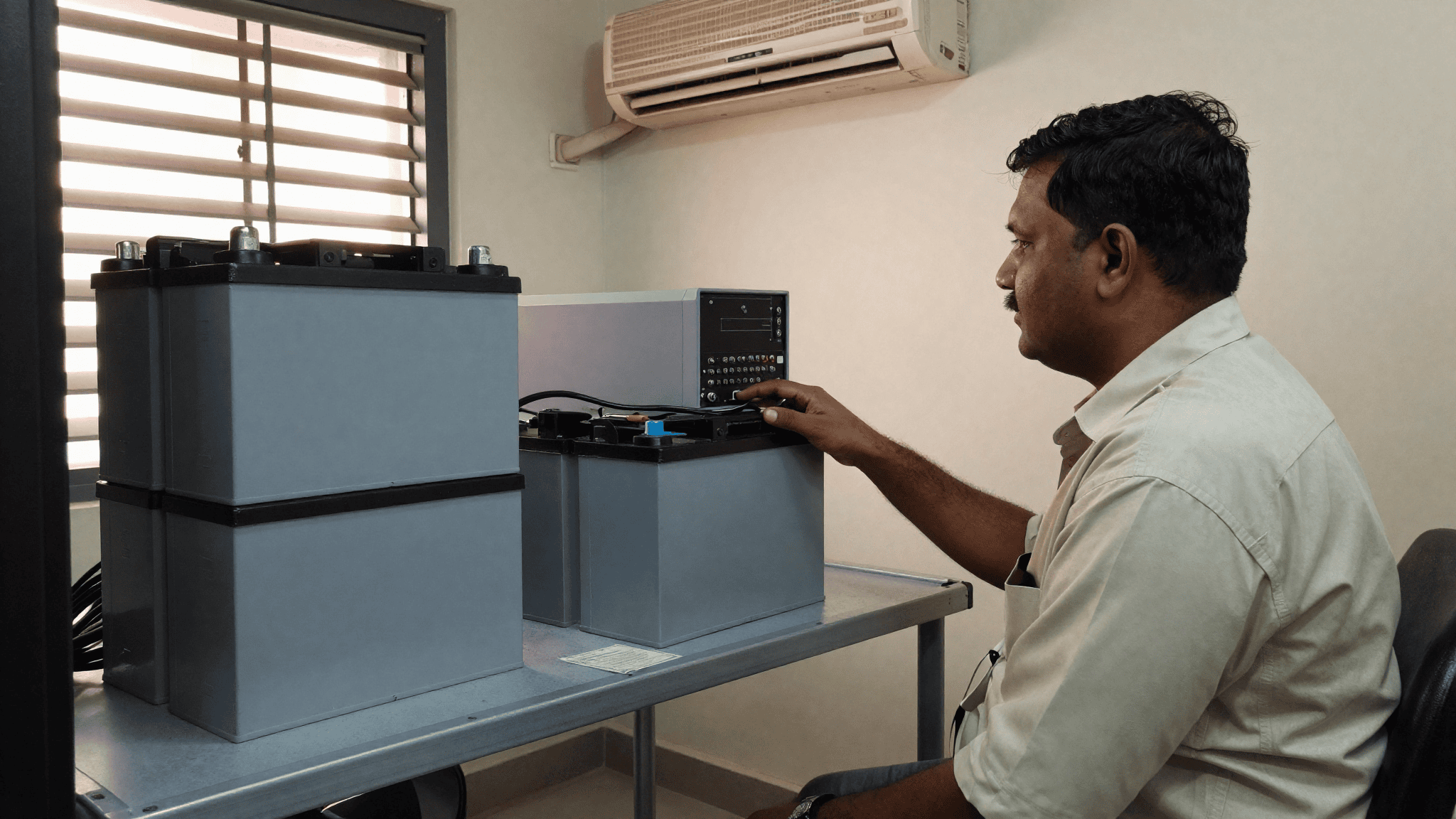
Their setup was normal for a mid-size Indian office. A 10 kVA online double-conversion UPS, two strings of 12V VRLA blocks, 30 minutes of runtime at full load. The pack lived in a cabin off the accounts floor. One split AC, always fighting. The cabin routinely touched 38 degrees in June.
That heat is the whole story. VRLA loses roughly half its rated life for every 8 to 10 degree rise above 25 C. Their pack was working at 35 to 38 for months at a stretch. Datasheet said 5 years. Real life was giving them 30 months, tops.
The July call was the second swollen block. Selvam had already replaced a full string in 2024. Owner was tired of it. His words were, “Riya, I don’t want to hear the word ‘battery’ again for ten years.” Bas. That was the brief.
What we swapped, and what we ran side by side
We did not rip everything out on day one. That would have been a jhamela nobody needed. We convinced the owner to run a controlled bake-off for twelve months.
Left leg of the UPS kept its VRLA string, brand new, freshly installed. Right leg got a lithium iron phosphate (LiFePO4) pack sized to the same 30 minute runtime at full load. Same UPS. Same load. Same room. Same air conditioner. The only variable was the chemistry.
We metered three things every week. Trickle-charge current draw, ambient cabin temperature, and any alarm the battery management system threw. At month twelve we opened both packs, tested capacity against nameplate, and compared.
The four numbers that changed everything
These are the numbers from that year. Not a datasheet. What actually showed up on their meters and invoices.
| Metric | VRLA leg | Lithium leg |
|---|---|---|
| Capex per 30-min string | ~ ₹ 1.10 lakh | ~ ₹ 1.72 lakh |
| Trickle-charge draw (kWh/year) | ~ 480 | ~ 240 |
| Cabin footprint | ~ 0.72 sqm | ~ 0.34 sqm |
| Ambient tolerance headroom | Rough at 35 C+ | Comfortable to 45 C |
| Expected replacement inside 10 years | 2 to 3 swaps | Zero, on this profile |
| Capacity after 12 months, tested | 93 percent of nameplate | 99 percent of nameplate |
The capacity retention line is the one that quietly won the argument. VRLA lost 7 percent in year one. Lithium lost 1. Project that curve out and you can see where the two chemistries part ways for good.
Get a straight-up quote for a lithium UPS on your site
200+ Indian businesses. First response inside 4 working hours. No card, no contract, no sales call.
When does the lithium premium pay for itself
The formula is simpler than the vendors make it look. Take your VRLA replacement interval in that specific room. Two or three years, if the room is warm. Multiply the full replacement cost (parts, labour, disposal, and the workday outage you scheduled) by however many swaps fit inside a 10 year window. Add the trickle-charge electricity delta at your local tariff. Compare that total to the lithium premium at day zero.
For most Indian offices we quote, the crossover point lands between month 34 and month 46. Faster if the room runs hot. Faster if you value not scheduling a Sunday outage every 30 months. Slower if you have industrial cold-storage-grade AC and a room that sits at a thanda 22 degrees all year.
Two variables move that crossover a lot. First, the ambient temperature we already talked about. Second, whether your UPS itself has 4 or more years of life left. If the UPS is old and going out soon, pairing a fresh lithium pack with a dying UPS is bad economics. In that case, do the whole refresh together. See how to size your UPS without overbuying for the sizing math we use before we quote either chemistry.
Some buyers ask us to run the sums against their older 5-year VRLA cost history. We do that too, and the shape is the same as our internal 5-year online UPS battery TCO calculation for India. The lithium leg wins by year 4 in almost every mid-size office we have costed.
Where lithium does not win, yet
Arre, we are not lithium fanboys. There are three cases where VRLA is still the right call.
One, when the UPS itself is 3 or 4 years from the end of its life. Do not marry a 12-year pack to a UPS that will be scrapped in year 5. Wait, and refresh both together.
Two, when the site truly does not need 30 minute runtime. If the goal is 5 to 8 minutes to trigger a DG start, VRLA at that small a capacity is genuinely cheap and the delta gets thin.
Three, when the vendor cannot show you a real BIS-certified LiFePO4 pack with a battery management system that talks to your UPS brand. There are cheap loose cells doing the rounds. If the seller cannot show test reports and a warranty an OEM will honour, walk away. Pakka.
Those three cases aside, the direction of travel is clear. State Bank of India’s Bhubaneswar LHO tender in January 2026 specified Li-Ion by default for a 250 kVA modular UPS with 30 minute backup, and allowed VRLA only as a fallback. When the largest public-sector bank in the country writes lithium into a tender as the default and lead-acid as the exception, that is the market speaking.
What Selvam and the owner did next
At month twelve they signed off on retiring the VRLA leg. We did the swap on a Saturday afternoon with the UPS on bypass for 40 minutes, a small portable pack covering the accounts server, and coffee for Selvam’s team. No downtime that mattered. The old VRLA blocks went to a licensed lead recycler with a proper Form 6 receipt. No dumping in the alley.
One year in, cabin temperature averages the same but the lithium pack does not care. Trickle-charge line item on the electricity bill dropped by roughly ₹ 3,200 a month. Owner has stopped asking about batteries. Selvam sleeps through July nights now.
The full room-and-rack plan we followed is close to the walk-through in our sizing a UPS for an Indian office field note, plus the ambient tolerance changes lithium buys you.
Ready to run this comparison on your own site?
200+ Indian businesses. First response inside 4 working hours.
Key takeaways
- Lithium pays for itself between month 34 and month 46 in a typical Indian office with a warm server cabin.
- Ambient temperature above 30 C cuts VRLA life in half. Lithium takes it in stride up to 45 C.
- Run the comparison on the site, not on a datasheet. Every room has its own quirks.
- Do not marry a fresh lithium pack to a UPS with 3 years left. Refresh the pair together.
- Ask for BIS certification, a real battery management system that talks to your UPS, and an OEM-backed warranty. No loose cells.
FAQ
Is a lithium UPS pack safe for a normal office server room in India?
Yes, if it is a proper LiFePO4 pack from a reputable maker with a working battery management system. LiFePO4 is the safest lithium chemistry in wide UPS use. It handles Indian ambient conditions better than VRLA, and does not vent hydrogen. Avoid loose cells and unbranded packs.
How much more does a lithium UPS pack cost compared to VRLA?
Roughly 40 to 55 percent more at day zero for the same runtime, at 2026 India prices. That premium closes by year 3 to 4 on most sites because VRLA has to be replaced two or three times inside a 10 year window. Trickle-charge electricity and space savings add to the lithium side of the ledger.
Can I put a lithium pack behind my existing UPS or do I need a new UPS?
Depends on the UPS model. Newer double-conversion UPS units from most major brands support LiFePO4 with a firmware setting and a compatible battery management module. Older models often cannot. Ask the vendor to run a compatibility check before quoting. If the UPS is 4 years or older, refresh both together.
What is the real service life of a lithium UPS pack in an Indian office?
10 to 15 years is the standard OEM claim, and the field data we have from three-year and four-year installs is tracking against that. Warmer rooms shave a little off the top end. Cooler rooms hit the full 15. You should expect zero pack replacements over the working life of a typical UPS refresh cycle.
The one-line answer, if you skimmed
Lithium wins the TCO fight for almost every mid-size Indian office we quote. VRLA still makes sense in exactly the three cases above. Ask your vendor to price both. If they cannot show you a real BIS-certified LiFePO4 pack with a working BMS, get a different vendor.
Start with a quick site survey
Every week you delay, the summer heat compounds the wear on your existing VRLA pack. Talk to us on WhatsApp at +91 91375 93228 between 10 and 7 IST, or use the button above.
See our full BPE UPS India page for the specific modular and standalone units we deploy with lithium packs.
P.S. Sudeep here. We shipped a similar setup for a Chennai insurance firm last month. Same story as Selvam’s. Two VRLA replacements in three years, one hot room, one owner who was done with the jhamela. Twelve months in, their line to us was, “It works, sir. Why fix what works.” That is the receipt.