Logitech meeting room kit India: a Bengaluru SaaS six-room rollout
Monday, 08:10 IST. The office manager was waiting at the lift with two coffees. The taller one was for me. She had been the unofficial first-line support for video calls in this Bengaluru SaaS office for the better part of a year. Her actual job was operations. The Logitech meeting room kit India project was meant to give her that job back.
The brief from the CFO was simple. Six rooms. Four days. Every room had to sign in to Microsoft Teams Rooms by Thursday end of day. Friday was an investor town hall. The investor was joining from Singapore. If the audio dropped, the round-up call the following week was going to open with that complaint, not the quarterly numbers.
The room mix that nobody had bothered to write down
We had walked the office twice already. The room inventory the IT lead handed me on the first visit was wrong in three places. One room had been converted from a phone booth to a four-seater huddle without anyone updating the asset register. Another had a wall-mounted 55-inch display the property team had installed but nobody had ever turned on. The boardroom had a 75-inch panel and a 2019 USB soundbar that was hard-clipping anything above conversational volume.
So the first thing we did on Monday morning was re-measure every room with a tape and a sound meter. Room area, ceiling height, longest mic pickup distance, average ambient noise during a typical 11 AM call. The huddle rooms came in at 4 to 6 square metres. The boardroom was 32 square metres with a long oval table. The town-hall room held 28 seated and another 12 standing along the back wall.
For the huddle rooms, the Logitech business accessories range we work with made the Rally Bar Mini the natural pick. AI-driven framing, integrated speaker, 4-mic beamforming, and it ships as a single appliance the Tap controller signs into directly. For the boardroom and town-hall room, the Rally Bar with two expansion mic pods and a Tap on the table. The phone room got a MeetUp because nobody was going to walk into a 3.5 square metre room and need beamforming. Logitech publishes the room-size guidance themselves on their India B2B video conferencing site and the spec we pulled matched what we measured on the floor.
Day 1, 14:00 IST. The boardroom decides the order
We did the boardroom first. Not because it was the highest priority, but because if the boardroom landed clean by Tuesday morning, the rest of the office would believe the rollout was real. Trust on an internal rollout is built in the first 20 hours. Lose those, and every subsequent room install gets pushed because someone has a meeting they would rather not move.
The boardroom Rally Bar mounted under the 75-inch display on a bracket that we had pre-tested. Two expansion mic pods went on the table, one at each long-axis end. Tap on the table on a 5-metre Cat6a run we pulled fresh through the existing cable tray. The IT lead asked why we were not just running USB. Because USB-C over 5 metres on a conference table that gets cleaned with random disinfectant once a week is the next ticket waiting to happen. Cat6a runs power and the Tap controller and survives the cleaning crew.
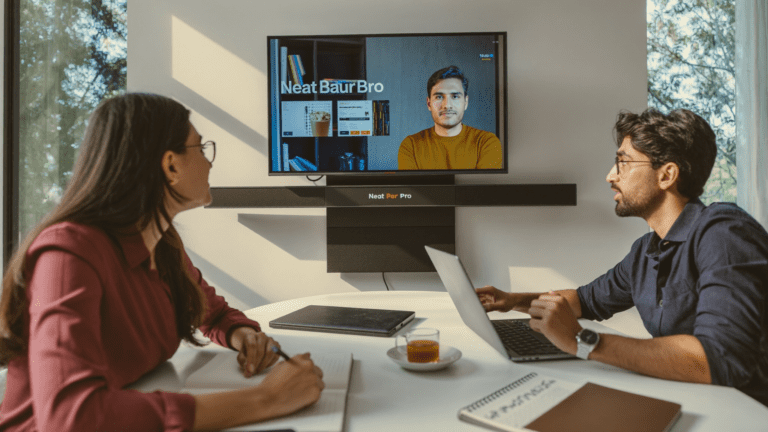
The room signed into Microsoft Teams Rooms on the Logitech CollabOS image on the first try. We had pre-staged the deployment account credentials with the IT lead the previous Thursday. The Tap booked the room directly off the existing Outlook calendar resource. Microsoft keeps a current list of certified Teams Rooms devices on their official Teams Rooms certified hardware page, and the Rally Bar family had been on that list since 2022. By 17:30 the boardroom was running a real call with the CFO and a vendor from Hyderabad. Audio held. Camera framing tracked. The CFO walked out and said “okay, do the others.” Bas. That was the green light we needed.
Day 2 to 3. Three huddles and a phone room
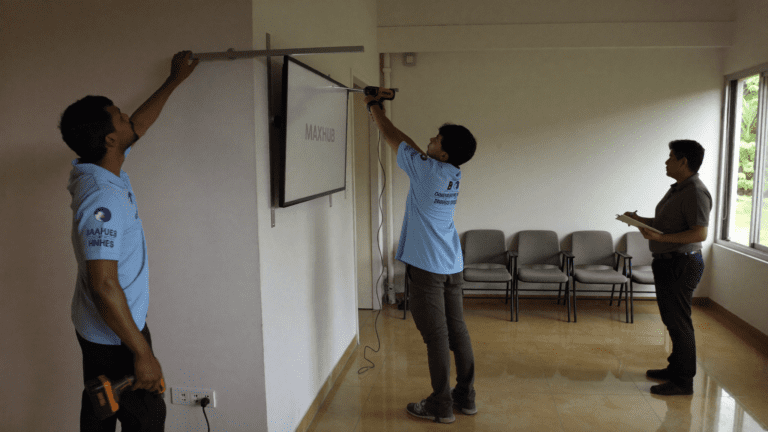
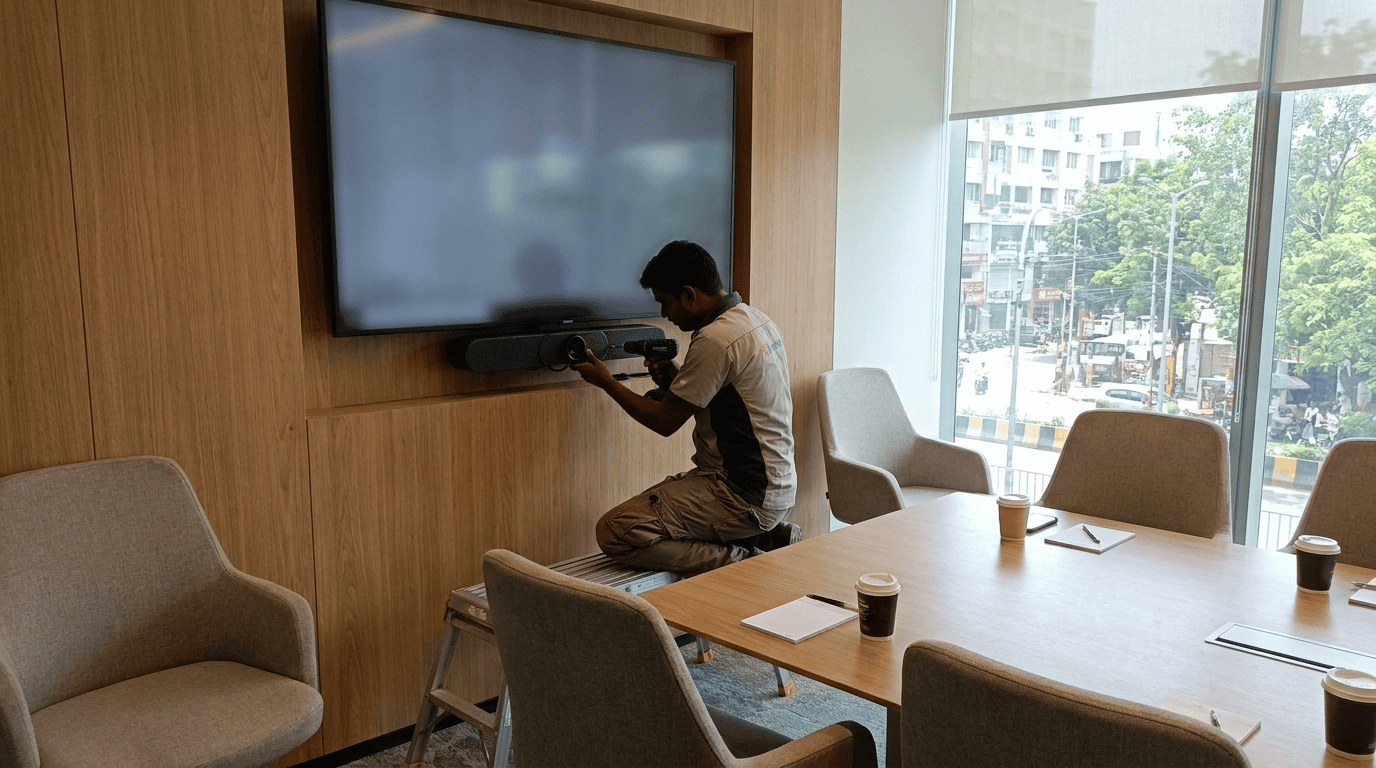
The three huddle rooms ran on a copy-paste pattern. Wall-mount the display if it was not already there. Wall-mount the Rally Bar Mini under it. Run a single Cat6a back to the patch panel for the Tap. Sign in. Test. Move to the next room.
The third huddle room threw the only surprise of the week. The display the property team had installed was a consumer-grade 4K TV from 2022. It worked, but it did not have CEC support on the HDMI input the Rally Bar Mini was using. So the room would wake the bar but not the display, and the user would walk in to a green LED with no picture. We swapped the display for a 55-inch commercial panel from our spares pool and moved the consumer TV to the cafeteria as digital signage. The IT lead added “verify display CEC” to the deployment checklist for the rest of the office.
The phone room MeetUp was the easiest install of the week. One USB-C cable to the wall plate, one display under it, one Tap on the small ledge. Twenty minutes including the sign-in and the test call. The MeetUp’s wide-angle lens framed the room top to bottom on a single occupant without the user having to move the chair.
Day 4 morning. The town-hall room and the investor test
The town-hall room was the riskiest install. Forty potential occupants, a long throw from the back wall to the camera, and the Friday investor call was now 28 hours away. We brought the Rally Bar plus two expansion mic pods on long cables. The pods went on stands either side of the seating cluster so the back-row standees were inside the beamform pickup. The display was an existing 86-inch panel, commercial grade, that the property team had specced correctly the year before.
The first test call into the room was a dial-in to one of our own offices. The audio at the back of the room came back clean at conversational level. We had the office manager walk to the door, then to the side wall, then to the back wall, and read a paragraph off a printed page. The remote end heard every syllable. Then we ran the same test with the air conditioning on full and the projector fan running. Still clean.
The investor call on Friday opened with the CFO welcoming Singapore. The audio held for 62 minutes. The framing followed the CFO and the CTO when they took turns at the podium. The “is the audio okay” check at the top of the call was the last time anyone asked. The CFO closed the round-up call the following week with quarterly numbers, not a complaint.
The cost picture and the bits people forget
The kit-only line on the BOQ landed at about Rs 14.8 lakh for the six rooms. Two Rally Bars at the high end, three Rally Bar Minis at the mid tier, one MeetUp at the entry tier, six Tap IP controllers, four expansion mic pods, mount brackets, and the cable runs. The hidden line item people miss is the Microsoft Teams Rooms Pro per-device licence. Without it, the Tap will sign in but you lose the management plane, the remote restart, and the proactive health alerts. Plan Rs 4,200 per room per year for that licence at India street rates, and budget for renewal in the same cycle as the hardware warranty.
The labour line was 4 working days across two engineers plus the cabling crew. We standardised the deployment account and the room naming convention the previous Thursday so that every Tap signed in to the right calendar resource without a human typing a password during the install. Pre-staging is the difference between a four-day rollout and a six-day rollout with three rooms missing on go-live morning.
The warranty conversation is the third thing people forget. Logitech Select is the enterprise warranty tier that ships next-business-day spares to India through authorised partners. It is not a default. You buy it line-by-line per device or as a fleet contract. Without it, the standard warranty path runs through the same RMA queue as a retail webcam and that timeline does not match a hybrid office that has six rooms going dark on a Monday.
What we would do differently next time
Two things. First, the display audit. We had assumed the existing displays were all CEC-capable. That cost us a swap and half a day. Next office, the room walk-through includes a display capability check before we cost the BOQ. Second, the cabling. We pulled fresh Cat6a to every Tap because the existing structured cabling at this office was 2018 vintage and the patch panel was running hot. The new runs added about Rs 38,000 to the project but eliminated the gamble. If the existing cabling is younger than 2022 and tests clean to Cat6a spec, the next office will reuse it.
The office manager got her job back. The IT lead stopped getting Slack pings at 09:55 every morning. The CFO presented investor numbers without an audio asterisk in the call. Those are the three outcomes the room kit was actually for. The hardware is the means. For the rest of the room stack like printers, displays, and access control we run on the same install plan, the Cisco UCS India rollout pattern we documented is a useful comparison piece. Our Optoma laser projector go-live day covers the auditorium variant of the same room-AV thinking, and the CommScope SYSTIMAX MDF recert piece is the structured-cabling sibling for offices where the patch panel is the limiting factor.
FAQ for India meeting room AV teams
How do I pick between a Rally Bar and a Rally Bar Mini for an Indian office huddle room? Room area is the first cut. Under 18 square metres with two to six seats, the Rally Bar Mini covers the audio and video on its own. Above that, or a long oval table where the far end is more than 3.5 metres from the camera, the Rally Bar with expansion mic pods is the safer pick. Ceiling height matters too. Above 3.2 metres, you want the bigger driver array.
What does a six-room Logitech rollout typically cost in India? Box-and-mount budget runs from Rs 12 lakh to Rs 18 lakh for a six-room mix depending on the ratio of huddles to boardrooms. Add Rs 25,000 per room for licences and per-year support. Add labour and structured cabling on top, typically Rs 40,000 to Rs 80,000 across the project. The all-in for a six-room office on a four-day rollout lands between Rs 16 lakh and Rs 22 lakh in India street pricing.
Can I run Microsoft Teams Rooms and Zoom Rooms on the same Logitech device? The CollabOS image lets you switch between Microsoft Teams Rooms on Android and Zoom Rooms appliance mode on the same hardware, but not at the same time. Pick one as the primary platform for the room. Zoom Rooms keeps its own appliance compatibility matrix if your office is Zoom-primary. Most India SaaS offices we work with run Teams as primary and use the Microsoft Teams direct guest join to handle the occasional Zoom invite without switching the room over.
What is the Logitech service network in India like? Logitech works with authorised distribution and service partners across major Indian metros. Standard warranty is one year. The Logitech Select enterprise tier adds next-business-day on-site response, advance replacement, and a named TAM for fleets above 25 devices. We carry a spares pool of common bars and mic pods so your rooms stay live while a manufacturer RMA runs.
P.S. Riya here. We ran the same four-day pattern at a Hyderabad fintech office a fortnight ago. They asked the same question you probably are right now: can we really keep all six rooms standardised on one vendor, or do we mix Poly into the boardroom and Logitech into the huddles? My honest answer: pick one. Two vendors means two firmware schedules, two warranty queues, and two helpdesk runbooks. The helpdesk cost of mixing is the line item nobody puts in the BOQ.
For the full Logitech room portfolio, India pricing bands, and the honest Logitech vs Poly vs Neat vs MAXHUB comparison, see our Logitech video conferencing India page.
Reach us on WhatsApp at +91 91375 93228 during 10-7 IST. Or write to care at siriusstar dot in for the room walk-through. We answer in under 4 hours on working days.
The longer read for Indian buyers who want the real numbers before they commit.
Send me the field guide