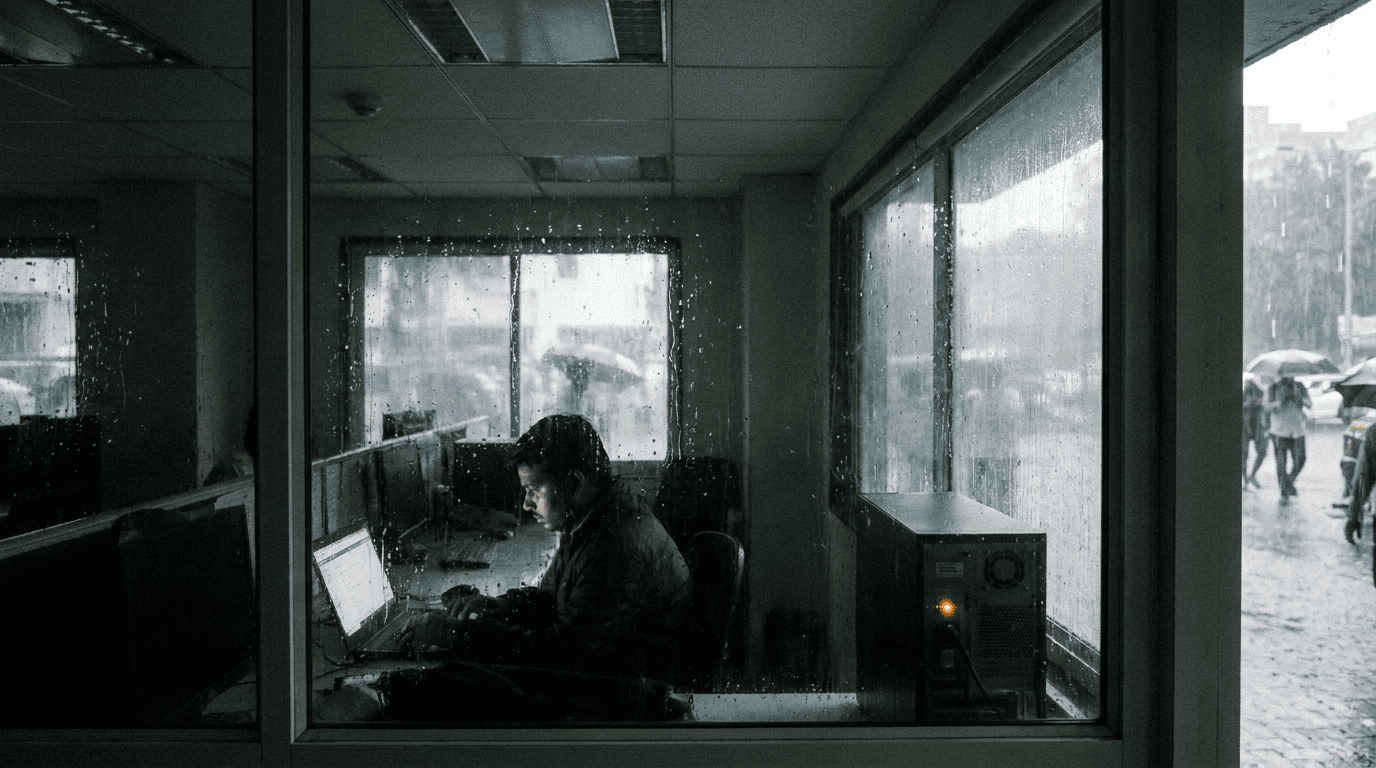
BPE UPS in Mumbai Monsoon: Lower Parel Friday Log
TL;DR: A 90-seat Lower Parel BPO ran on a tired 10 kVA UPS until a near-miss in March. They swapped it for a BPE Optima online double-conversion unit and a second small Polo lithium parallel. July 4, 11:17 AM, the Hindustan substation tripped after two hours of heavy rain. 4-hour outage. Three rack switches and one storage controller never noticed. Cost of one lost uptime hour at 90 seats with active US client calls: ₹3.8 lakh. Cost of the BPE upgrade: ₹2.1 lakh, recouped on day one. Three things saved them.
Priya Mehta runs IT for a 90-seat managed-services firm in Lower Parel, Mumbai. She has lived through three monsoons that took the building down and she will tell you, flatly, that until March 2026 she was running on luck. This is her log of one Friday in July, and what BPE UPS hardware did when the grid went away for four hours and twelve minutes. The rack-power topologies she now understands the hard way are documented in the APC UPS topology guide if you want the engineering reference.
11:17 AM: the lights go funny
The tubelights flicker once, hold, then flicker again. TVs on the wall reboot. Somebody on a Teams call says “you cut out for a second” and everybody pretends it did not happen. Priya looks up at the AC. It is humming. The Wi-Fi AP above her is green. The rack-monitoring dashboard on her laptop is live. So far normal.
Her phone buzzes. The security guard from the ground floor: “Madam, building has gone. Lift dead. BMS red.”
Outside, the rain is doing its thing. Andheri has been getting hammered since 9 AM and the substation feeding their pocket of Lower Parel has just given up. Right now Priya has 90 people on calls with US clients, a 6U rack with three Cisco switches and a NetApp head, and 12 minutes before the building’s diesel generator should kick in. Twelve minutes that, last August, was actually 47 minutes because the DG controller had a stuck relay. She remembers because they lost a ₹14 lakh helpdesk renewal that week.
11:19 AM: the BPE display tells the truth
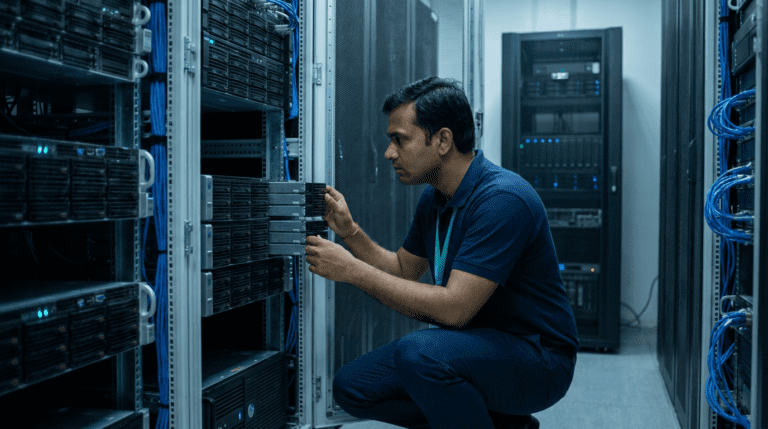
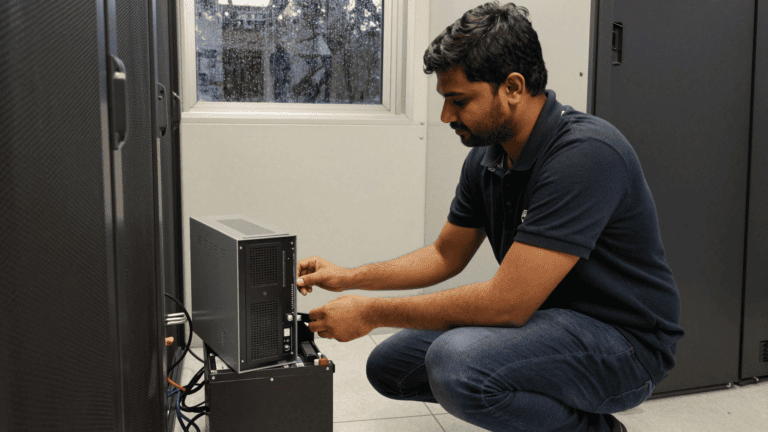
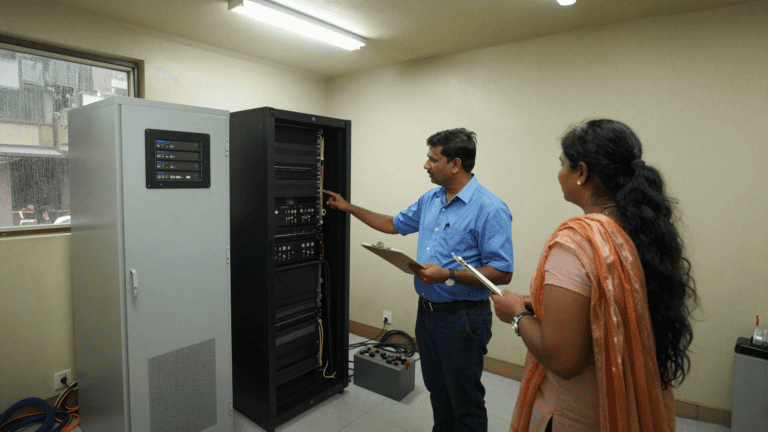
She walks to the server room. It is a small one, 8 feet by 10, two racks, one wall-mounted BPE Optima Plus 10 kVA online unit, and a smaller BPE Polo lithium module bolted next to it as a parallel slave. Both displays are live.
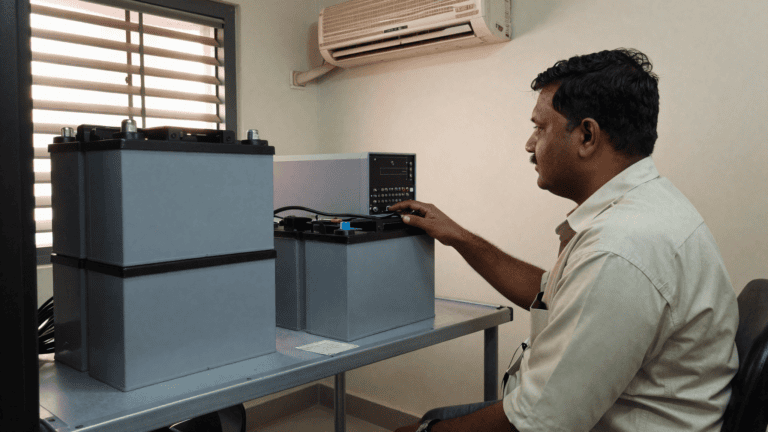
The Optima screen says: Mode: Inverter. Load: 38%. Battery: 96%. Runtime at current load: 41 minutes.
The Polo says: Standby. Cells balanced. Capacity 100%.
Forty-one minutes. That is the number that matters. The DG controller, post-replacement, takes about 90 seconds. So she has 39 spare minutes if the genset behaves, and roughly 4 hours of runtime if the Polo parallel kicks in once the Optima string drops to 30%. The math, for the first time in her career, was actually true to what the spec sheet said.
She goes back to her cabin and sends a one-line note on the team channel: Power gone, racks fine, calls fine, do not log out.
11:31 AM: the DG behaves (this time)
Fourteen minutes in, the DG controller logs the start. Priya can hear it from the server room: a low thrum, then the room AC kicks back on. The Optima display blinks once and switches to: Mode: Line. Charging at 1.2 kW. Battery: 91%.
It is not dramatic. Nothing on the rack noticed. The Cisco switch uptime counters tick on. The NetApp controller never logged a power event. The CCTV NVR, which Priya had patched into the same UPS line two weeks earlier, kept recording the lobby.
This is what an online double-conversion UPS is supposed to do. It is also what her old line-interactive box was definitely not doing last August, when a 4-millisecond transfer time was enough to drop the NetApp’s NVRAM cache and force a 23-minute file-system check on restart. That was the day she started writing the upgrade case.
12:48 PM: lunch and the boring weekly report
Around lunch, she calls Rajesh from Sirius Star. He is the channel partner who shipped the BPE rig in March. She wants to thank him, and also vent. He picks up on the second ring.
“Bas, Rajesh, it actually worked,” she says. “The thing did exactly what you said it would do.”
He laughs. “Madam, you read the weekly battery report I set up for you?”
She has not. Honestly, the email goes into a folder she opens once a month if at all.
“Open it now,” he says.
She does. It is one page. Three numbers per UPS: internal resistance trend per cell string, ambient temperature trend, full-load self-test pass count over the last 30 days. The Optima had run a full discharge test on the second Sunday of June, and the report said the runtime came in at 38 minutes at 40% load. The number she saw on the display this morning was 41 minutes at 38% load. Within margin. The hardware was telling the truth.
“That report is the boring thing that saves you,” Rajesh says. “On the old box you had no test. The first time you found out the battery was tired was when the grid went and the load dropped at minute four. With BPE we test every two weeks and we tell you 21 days before a string needs swapping. Pakka.”
1:42 PM: the second outage
This is the part nobody plans for. The grid comes back briefly at 1:14 PM. The DG cuts over to mains. Three minutes later the grid drops again. The DG has to restart. This is the failure pattern that fries half the UPS systems in Mumbai every July, because the inrush during cutover and re-cutover hits transformers that have not cooled.
Priya is in the server room with her phone torch on. The Optima display: Mode: Inverter. Load: 41%. Battery: 88%. Runtime: 36 minutes. The Polo slave, topped up during the brief mains window: Standby. 100%.
If the DG does not come back in 36 minutes, the Polo parallel assumes the load and she has another 3 hours. The DG controller logs a restart at 1:47 PM. Five minutes total. The Optima goes back to charging. The Polo never had to engage. But she is glad it is there.
3:30 PM: the five-line postmortem
By 3:30 PM the grid is back for good. Priya writes the postmortem her CFO will actually read:
- Outage: 4 hours 12 minutes. Two grid events. One DG restart.
- Production impact: zero seats lost. Zero call drops attributable to power.
- Rack impact: zero reboots. NetApp cache intact. NVR recording continuous.
- UPS state at end: Optima 84%, Polo 100%, ambient 28C, cells in balance.
- Avoided cost: roughly ₹15.9 lakh against the August 2023 benchmark. Day-one payback.
She adds one ugly line for herself: We almost cancelled this purchase in February. CFO asked if we could just buy two more car batteries and chain them. I almost said yes.
What the BPE UPS did differently
The Optima is a real online double-conversion machine, not a line-interactive box dressed up as one. The AC coming out of the inverter has been generated fresh from the DC bus, regardless of what the input looks like. When the grid trips, there is no transfer time. This is the difference between “my UPS works” and “my rack never noticed.” The same topology underpins the HPE rack power reference for ProLiant servers in Indian datacenters.
The Polo lithium parallel adds two things. Cycle life that does not collapse at the 2-year mark the way sealed lead-acid does. A real BMS that tracks per-cell health and refuses to discharge a string that has gone out of balance. The runtime number on the display is the number she will actually get. The matching enterprise pattern for lithium-backed racks is documented in the IBM Power Systems rack-power guidance.
For a 90-seat operation with one rack of real workload, the spec that matters is this:
- Optima Plus 10 kVA online: covers the rack, the AC for the server room, the NVR, and the wall AP cluster. Sized for 38% steady load so it has headroom for the moments a switch reboots and pulls 1.5x rated for a few seconds.
- Polo lithium 5 kVA parallel: standby, kicks in only if the Optima string drops below 30%. Buys roughly 3 hours additional runtime.
- Weekly battery report: emailed every Monday morning. Internal resistance, ambient, test pass count. Boring. Saves you.
Where the alternatives sit
Priya looked at three other options before signing. Here is the honest comparison her CFO got, anonymised for the public version:
| Option | Capex (10 kVA online) | What it nailed | Where it lost |
|---|---|---|---|
| BPE Optima Plus | ~₹1.6L | Made-in-India service window. Channel partner in same pincode. Real online topology. | Brand recognition lower than the global players. |
| Delta Amplon | ~₹2.1L | Excellent firmware, granular monitoring. | Service window pricier on AMC year 3-5. Worth a look if you want the Amplon family. |
| Eaton 9PX | ~₹2.6L | Best-in-class for compliance-heavy estates. ePDU integration. | Overspec for a 90-seat single-rack site. Eaton makes sense at 20 kVA upwards. |
| Line-interactive 10 kVA (budget) | ~₹0.7L | Cheap up front. | Transfer time kills your NetApp cache. Don’t. |
If you want the longer compare on the bigger end of the market, the team also wrote up a Hyderabad rack-pod call comparing Schneider Galaxy and Vertiv Liebert at 60 kVA. That one is here and the trade-offs at that scale are different.
The Pune fintech postmortem from May is also worth a read if you care about how a power event cascades into a thermal-and-storage problem, not just an uptime problem. Read it here. The short answer: the UPS keeps the rack up, but if the room AC also dies, you have a 15-minute window before you have a different kind of outage.
What Priya wishes she had done one month earlier
One thing. Started the weekly battery report on the old UPS too. Not the new one. The old one. The report would have told her in late January that the back string was at 0.42 ohms internal resistance against a 0.18 ohm baseline. She would have known the unit was three weeks from failure. The March near-miss would not have happened. The BPE rig is the answer for the next six years. The boring weekly email is the answer for the rest of her career.
Sizing a BPE setup: the five questions to answer first
This is what the Sirius Star team walks every customer through before quoting:
- Measure real steady load over a week at three time slots. Not nameplate. The spread tells you 10 kVA versus 15 kVA, and whether you need a lithium parallel.
- Get your DG controller tested under load. Roughly 60% of mid-size Mumbai sites have a DG that starts fine but fumbles the transfer. The UPS cannot save you from a stuck relay.
- Ambient in the server room. Above 30C, runtime drops 25 to 50%. Plan the AC source carefully.
- Weekly battery report in the AMC contract. Internal resistance, ambient, test pass count. Three numbers. Read it Monday morning with your chai. Bas, this is the discipline.
- Service engineer in your pincode. A BPE engineer 20 minutes away beats a global brand on a 6-hour SLA. Ask for their name.
For the full catalogue, sizing tool, and AMC pricing, the BPE UPS India page has the current Optima, Polo and Sentry SKUs.
The numbers: capex, AMC, avoided cost
Total capex on the BPE rig in March 2026: ₹2.1 lakh for the Optima Plus 10 kVA plus the Polo 5 kVA parallel, install and commissioning included. AMC year 1 was bundled. AMC year 2 onwards is ₹18,000 a year for the pair.
Avoided on July 4: roughly ₹15.9 lakh of downtime cost benchmarked against the August 2023 event. Plus the NetApp cache check Priya did not have to run. Plus the helpdesk renewal her firm did not lose. The actual deliverable of a working BPE UPS setup is not the kit. It is the afternoon back.
Reach the Sirius Star hardware team on WhatsApp during 10 to 7 IST. Free four-hour quote, no card, no sales call until you ask for one. Bureau of Indian Standards specifications (bis.gov.in) cover UPS equipment safety and performance in India, which is part of what a sizing checklist like this should hold up against.
Questions we get asked about this
How is a BPE UPS sized for a monsoon-prone Indian office?
Size for real load plus headroom for the longest outage you have actually seen, not the average. This Lower Parel BPO sized for a 4-hour outage after three monsoons of shorter cuts.
Is BPE a well-known UPS brand compared to APC or Schneider?
BPE is a smaller, India-focused brand than APC or Schneider, with a leaner AMC network. For offices already burned by an outage bigger than their UPS covered, the sizing discipline matters more than the badge on the unit.
What does a UPS sizing checklist actually cover?
Real load in kVA, runtime at that load, battery age and replacement cycle, and a tested transfer time. Most gaps we find are runtime assumptions that were never tested against an actual outage.
The longer read for Indian buyers who want the real numbers before they commit.
Send me the field guideP.S. Sudeep here. We shipped a similar BPE Optima plus Polo parallel setup for a 60-seat Andheri legal-process firm in April. They had the same near-miss story Priya did. Their CFO asked the same Parle-G question about car batteries. Three months in, they sent us a one-line WhatsApp during the May power-cut week: “Bas, racks did not move.” That is the entire sales pitch.