Choosing a commercial display for retail: a Coimbatore store diary
Last updated: 29 June 2026
The 55-inch screen at the front of the Coimbatore flagship was still showing a Pongal offer. In June. A frozen still frame, fan inside whirring like it wanted to leave, glass warm to the touch when I put my hand on it.
Vasanth runs IT and store operations for a 14-store apparel chain across Tamil Nadu. He had called us because three entrance screens had failed in the same quarter. Two were stuck. One had a magenta band down the left third. All three were consumer televisions bought from the same big-box store as the ones in his own living room.
This is the story of how he stopped buying televisions for his shops. If you are picking screens for stores right now, the cost that matters is not on the price tag. It is the screen that dies during a Saturday sale.
The 8 AM frozen screen
Here is what a dead entrance screen actually costs. A store manager notices at opening. He calls the area manager. The area manager calls Vasanth. Somebody drives a replacement TV from another store or from the warehouse. By the time the screen is back, it is afternoon and the morning footfall has walked past a blank wall or a frozen Pongal banner.
Vasanth had a spreadsheet of these incidents. Eleven screen failures in 14 months. Each one a phone call, a drive, a manager pulled off the floor. The screens themselves were not even the biggest line. The jhamela of fixing them was.
The root cause was simple once we walked the stores. A home TV is designed for maybe four to six hours of viewing a day, in a cool room, with the brightness turned down. A shop runs its entrance screen 12 hours, every day, often in direct sun through a glass front, brightness pushed to maximum to fight the daylight. The panel never gets to rest. The power supply runs hot. Eighteen months in, it gives up.
Arre, nobody sells you that part. The box just says 55-inch 4K, and it looks identical to the commercial one on the shelf next to it.
Why consumer TVs keep dying in retail
Three things separate a home TV from a screen built for a shop floor, and a buyer cannot see any of them in the showroom.
First, the duty cycle. Commercial panels are rated for 16/7 or 24/7 continuous operation. The components are specified for it. A home panel is not, and the warranty usually says so in small print, which means a failure at month 14 in a shop is often not even covered.
Second, brightness. A typical home TV sits around 300 to 350 nits. Behind a glass shopfront at noon, that washes out to nothing. ViewSonic’s CDE commercial range runs 450 to 500 nits, which is the difference between a promo you can read from the road and a grey rectangle.
Third, control. A home TV expects a person with a remote. Vasanth had 14 stores, each manager loading promos off a USB pen drive that got passed around, lost, or loaded with last month’s offer. There was no single version of the truth about what was on screen where.
What a commercial display for retail actually has to survive
When you put a commercial display for retail through its real working life, you are asking it to do things a living-room TV never faces. All-day heat. Sunlight. A cleaning crew wiping it with whatever cloth is around. Power that dips and spikes. Months without a single restart.
We specced Vasanth’s stores around the ViewSonic CDE series. The CDE30 and CDE31 displays run native 4K, 500 nits, and a metal chassis with tempered glass instead of the thin plastic on a home set. The CDE31 carries Android 14 and 8GB of RAM on board, so the screen plays its own content without a separate media player taped to the back.
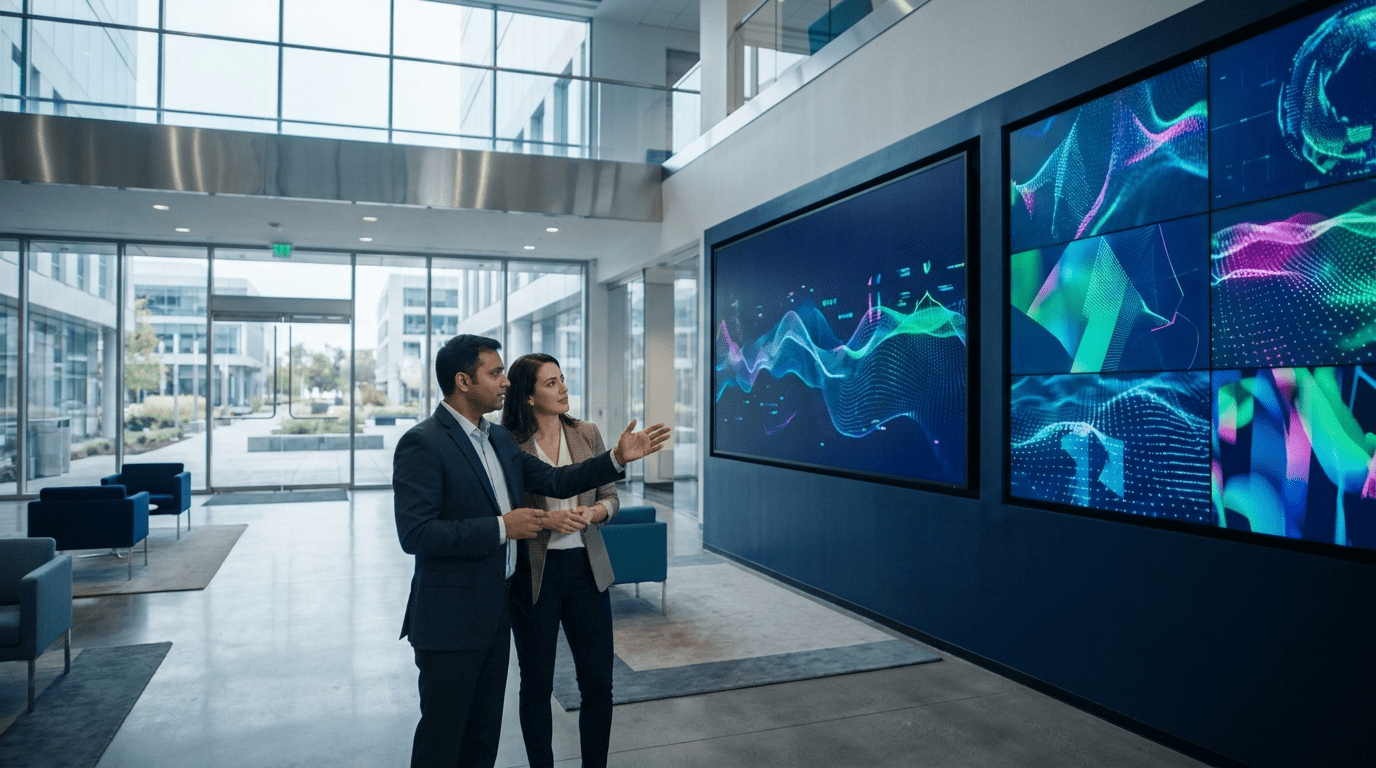
We mixed the sizes by job. Tall portrait 43-inch screens at the entrance for the headline offer. Landscape 55-inch above the billing counter for the loyalty and UPI prompts. A 65-inch in the larger Tiruppur store where the aisle is wide enough to read it from a distance. Same management layer underneath all of them.
One quiet thing mattered to Vasanth more than the spec sheet. The CDE displays carry a 3-year warranty, and ViewSonic India runs its own service line for commercial product. When a screen does fail, and one eventually will, he is not arguing with a consumer call centre about whether a shop counts as home use.
One dashboard for fourteen stores
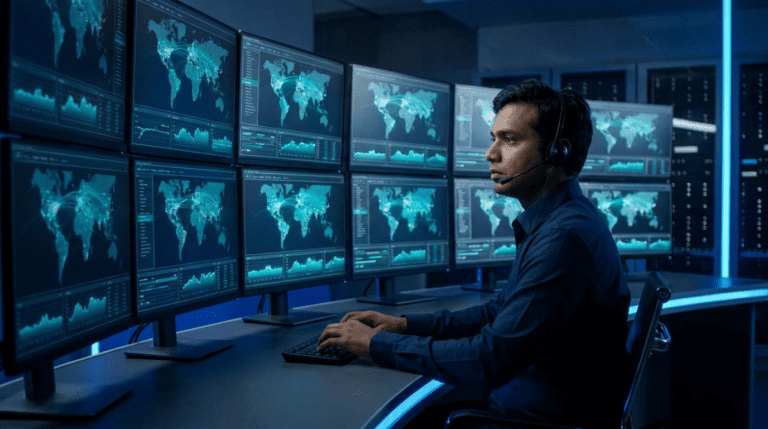
The part that changed Vasanth’s week was not the hardware. It was ViewSonic Manager, the cloud console that the Android CDE displays report into. From one laptop he can see every screen across all 14 stores, push a new promo to all of them at 6 AM before opening, schedule the Diwali creative weeks ahead, and get an alert when a panel goes offline instead of a phone call from a manager.
No more pen drives. No more “which offer is running in Erode.” Bas, one place to look.
It also closed a quiet risk. Some retailers pair entrance screens with footfall cameras and run basic analytics on who walks in. The moment a camera captures faces, that is personal data under India’s DPDP framework, and the penalties run up to 250 crore rupees. We have seen this catch retailers off guard. So we kept the signage layer and any camera layer clearly separated, lined the handling up against CERT-In guidance and ISO/IEC 27001 practice, and pointed Vasanth’s team at the rules early rather than after an audit. A screen rollout is a good moment to get that boundary right, while you are touching every store anyway.
The honest cost math over five years
Here is where most retail buyers get it wrong, and where I had my own bias checked. I walked in assuming the answer was obvious: spend more, buy commercial, done. Vasanth pushed back. He wanted the number, not the speech. So we built it.
A 55-inch consumer TV runs around Rs 40,000. A 55-inch ViewSonic CDE commercial display runs roughly Rs 60,000 to 70,000 depending on the model. On day one, the TV looks like the smart buy. Now stretch it across five years.
| Over 5 years, per entrance screen | Consumer 55″ TV | ViewSonic CDE commercial 55″ | Lowest-bid no-name |
|---|---|---|---|
| Purchase price | Rs 40,000 | Rs 65,000 | Rs 32,000 |
| Rated duty cycle | ~6 hrs/day home use | 16/7 continuous | Unstated |
| Likely replacements in 5 yrs | 2 to 3 | 0 to 1 | 3 or more |
| Brightness (sunlit shopfront) | 300 to 350 nits | 500 nits | Varies, often low |
| Central content control | None (USB) | ViewSonic Manager cloud | None |
| Warranty | 1 yr, home-use terms | 3 yr commercial | Patchy |
Buy the TV twice and you have already passed the commercial screen on spend, and that is before you count the drives, the manager hours, and the mornings of dead promo space. Pakka, the cheap screen is the expensive one. It just sends the bill later.
The lowest-bid no-name column is the one I steer people away from hardest. A screen with no stated duty cycle and a patchy warranty is a gamble dressed as a saving.
What we’d tell you before you sign the PO
Vasanth rolled out 38 screens across 14 stores over six working weeks. We staged it store by store so no shop lost its entrance display for more than a morning. Six months on, zero panel failures, and his promo calendar runs from one screen on his desk.
His store manager in Salem said the line I keep repeating to other retailers. “Sir, now the offer is correct everywhere. I don’t have to remember.” That is the whole point. The best screen in a shop is the one nobody on the floor has to think about.
If you are buying screens for stores, do three things. Check the rated duty cycle, not the resolution. Check the brightness against your actual shopfront, not a showroom. And insist on central control before you scale past three or four locations, because at fourteen, pen drives become a second job.
You can see the full ViewSonic Commercial Displays in India range we deploy, or compare paths on our interactive displays for business and LED displays and digital signage guides. If your need is a training room rather than a shop floor, the Pune L&D display diary is the closer read, and for auditoriums see our Optoma projector guide. Running meeting rooms too? The Bengaluru six-room Logitech rollout covers that. And managing several sites at once is the same muscle as our Udaipur three-property rollout.
FAQs
Can I just use a normal TV for my shop?
You can, and many retailers do until the screens start failing. A home TV is rated for a few hours of daily use, not a 12-hour shop day in sunlight. In our deployments they tend to fail inside two years, and the warranty often does not cover commercial use.
How many displays can one person manage?
With ViewSonic Manager, a single administrator schedules and monitors screens across every store from one console. We have set this up for chains running dozens of screens without adding headcount.
What size should an entrance screen be?
For most Indian retail entrances a 43-inch portrait or a 55-inch landscape reads well. The deciding factor is viewing distance and how much sun hits the glass, which is why we walk the store before quoting.
P.S. Sudeep here. We ran this exact rollout for a south India retailer last quarter, and the question Vasanth asked is the one every owner asks: why pay more for a screen. The answer only shows up in year two, when the cheap ones are in the e-waste pile and the ViewSonic ones are still running the morning promo. Buy the boring screen. Reach us on WhatsApp at +91 91375 93228, 10 to 7 IST, and we will plan it store by store.

Reviewed by Riya Kapoor · Riya Kapoor leads Sirius Star's hardware and infrastructure practice
Last reviewed: 29 June 2026